
Executive Summary: Safely navigating a wheelchair on an incline requires a clinical understanding of biomechanics, weight distribution, and momentum control. This guide outlines professional protocols for ascending and descending ramps to mitigate the risk of occupant falls and caregiver musculoskeletal injuries through proper stance, grip, and equipment selection.

Why Ramp Specifications Impact Caregiver Safety
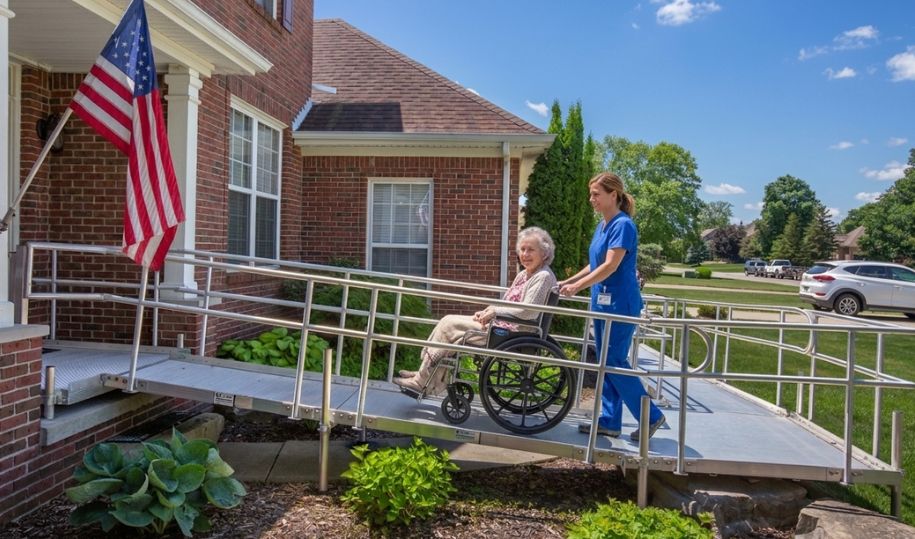
In a professional care environment, the coefficient of friction and the gradient of the incline are the primary variables in patient transport safety. An ADA-compliant rampātypically following a 1:12 slope ratioāis designed to minimize the physical force required for ascent. Before beginning any transport, a safety officer or caregiver must evaluate the anti-slip surface and ensure the path is clear of debris that could cause wheel occlusion or sudden stops.
Selecting an ADA-Compliant Ramp for Professional Use
Choosing the correct equipment is the first step in injury prevention. High-authority facilities prioritize aluminum modular ramps or heavy-duty portable systems that offer 2-inch safety curbs and high-traction "serrated" decking. These features prevent the wheelchair from veering off the edge during high-stress maneuvers.
Biomechanical Techniques for Ascending a Ramp
Pushing a wheelchair up an incline significantly increases the load on the caregiverās lumbar spine if improper form is used. To maintain stability and maximize power, professionals must follow a strict ergonomic protocol.
Core Positioning for Upward Transport
- The Power Stance: Stand directly behind the wheelchair with feet shoulder-width apart. Maintain a low center of gravity to prevent roll-back.
- The Leveraged Grip: Use both hands to firmly grasp the push handles. Avoid "death grips" that can lead to wrist fatigue, but ensure enough tension to react to sudden weight shifts.
- Occpany Coordination: Instruct the occupant to lean forward slightly. This shifts the center of gravity toward the drive wheels, increasing traction and reducing the effort required to push.
The "Reverse" Protocol: Safely Descending a Ramp
Descending a ramp forward is often the most dangerous method of transport, as it puts the occupant at risk of sliding out of the seat and forces the caregiver to resist the full momentum of the chair with their arm muscles alone. In professional clinical settings, the Reverse Descent is the gold standard.
How to Execute a Controlled Reverse Descent
Turn the wheelchair around at the top landing so the occupant faces away from the descent. The caregiver should walk backward down the ramp, using their body weight as a natural brake. This method provides the caregiver with maximum leverage and ensures the occupant remains securely seated against the backrest throughout the transition.
Managing Forward Descent on Shallow Slopes
If the incline is shallow and a forward descent is chosen, the caregiver should tilt the wheelchair back slightly to engage the larger rear wheels and prevent the front casters from catching on any surface irregularities. Maintain a steady, walking pace and never allow the chair to gain independent momentum.
Equipment Integrity: The Pre-Transport Safety Checklist
Operational outcomes are heavily dependent on the mechanical state of the mobility device. A failure in the wheel-lock system or inadequate tire pressure can compromise even the best pushing technique.
- Brake Calibration: Verify that the wheel locks engage fully and do not slip when pressure is applied on an incline.
- Tire Pressure: Low tire pressure increases the "rolling resistance," making the chair exponentially harder to push.
- Anti-Tip Bars: Ensure the wheelchair is equipped with anti-tip bars to prevent rearward capsizing during steep ascents.
Conclusion: Enhancing Accessibility and Professional Standards
By implementing these clinical techniques, organizations can foster a safer, more inclusive environment for mobility-impaired individuals. Professionalism in patient transport not only protects the patient but also ensures the long-term health and safety of the procurement managers, first responders, and caregivers on the front lines of accessibility.
Optimize your facilityās safety today: Shop our Professional Grade ADA-Compliant Wheelchair Ramps.

