






Modular Ramps for Wheelchairs
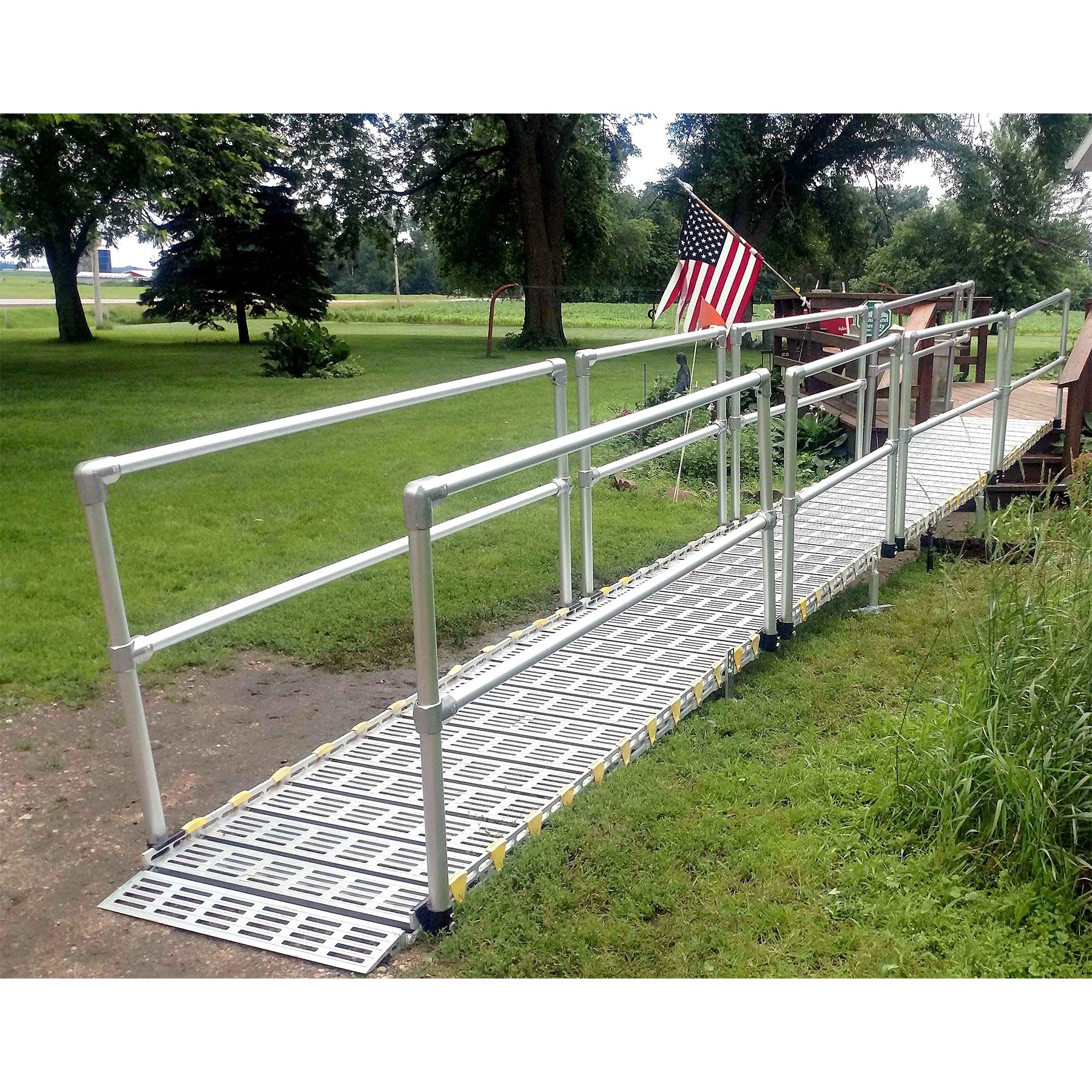
Modular wheelchair ramps give businesses, schools, churches, healthcare facilities and government buildings an accessible entrance without pouring concrete. Each system bolts together from aluminum ramp sections, platforms and handrails, so a facilities team or contractor can install it in sections, then add, reconfigure or relocate it later. For commercial entrances we carry the Rampit USA United Series in 48, 54, 60 and 72 inch widths and the National Ramp Breeze and Liberty Series, along with residential systems for homes.
Layouts are planned around the ADA 1:12 maximum slope for new construction, with landings and handrails for the full run. Send your total rise, available run length and entrance layout for a project quote . Tax-exempt orders accepted.
✓ ADA and IBC configurations Layouts planned around a 1:12 slope with landings and handrails. ⚙ Bolt-together sections No concrete pour. Add, reconfigure, or relocate later.
☀ Low-maintenance aluminum Does not rust and is light enough to install in sections. ↔ 36 to 72 inch widths Residential and commercial systems for any entrance. Buying for a facility, school, or agency?.
Request a quote with your total rise, available run length, and entrance layout. Tax exempt orders accepted. Send your exemption certificate with your quote request.
Talk to a ramp specialist: 800-239-1797 . Need help with ADA slope and landing planning? See our Ramp Length Guide .
Request a Quote Call 800-239-1797 . Commercial modular ramps. For businesses, schools, churches, healthcare facilities and government buildings, the Rampit USA United Series comes in 48, 54, 60 and 72 inch widths and is built for ADA and IBC configurations with platforms and handrails.
The National Ramp Breeze Series (open mesh surface) and Liberty Series (solid surface) also fit commercial entrances. See our commercial wheelchair ramps page for layout help and a project quote. Residential modular ramps.
For homes, the Rampit USA Independence Series comes in 36 and 48 inch widths, alongside the Rampit USA W.A.R. Series 39 inch wood and aluminum ramp and the Roll-A-Ramp 30 inch Home Access and 36 inch Modular ramps. See wheelchair ramps for home and our Residential Modular Wheelchair Ramps guide .
How to choose a modular wheelchair ramp. Measure the rise. Measure straight down from the top of the threshold or landing to the ground where the ramp will end.
Every other choice starts with this number. Work out the ramp length. The ADA standard for new construction is a maximum slope of 1:12, which means 12 inches of ramp for every inch of rise.
A 24 inch rise needs at least 24 feet of ramp at that slope. Use our Ramp Length Guide to plan the run. Pick the width.
Compare the width of the wheelchair or scooter with the clear width between the rails. Residential systems such as the Rampit USA Independence Series come in 36 and 48 inch widths, while the United Series goes up to 72 inches for commercial entrances. Plan platforms and turns.
Long runs and entrances with a turn need platforms that connect ramp sections into straight, L-shaped or switchback layouts. Check each product page for the platforms and sections that work with that system. Choose a surface.
National Ramp offers an open mesh surface on the Breeze Series and a solid surface on the Liberty Series. The Rampit USA W.A.R. Series pairs a wood and aluminum design.
Check capacity and handrails. Confirm the rating for the complete installed system covers the user, the device and any helper, and plan handrails for the full run. Related resources: wheelchair ramps , Ramp Length Guide .
Planning guides: commercial ramp requirements , planning a commercial ramp project , facility manager's guide to ADA ramps .


Rampit USA 48" Wide Independence Series | Heavy-Duty Residential Access Ramp
Factory Direct Ships in 5-7 Business Days! (Estimated) View Product

Rampit USA 36" Wide Independence Series Residential Ramp | Maintenance-Free Aluminum Access
Factory Direct Ships in 5-7 Business Days! (Estimated) View Product

Roll-A-Ramp 30" Home Access Ramp – Portable & Adjustable
In Stock Ships in 2-3 Business Days! (Estimated) View Product

National Ramp Liberty Series Solid Surface Aluminum Ramp | 36" and 48" Wide
Factory Direct Ships 2-3 Days! (Estimated) View Product

National Ramp Breeze Series Open Mesh Aluminum Ramp | 36" Wide, 2' to 6'
Factory Direct Ships 2-3 Days! (Estimated) View Product
Roll-A-Ramp 30" Modular Ramp System | Portable Aluminum Roll-Up Ramp, 5' to 30'
In Stock Ships in 2-3 Business Days! (Estimated) View Product

Rampit USA United Series 72" Commercial Modular Ramp | 4' to 8' Lengths
Factory Direct Ships 2-4 Weeks! (Estimated) View Product

Rampit USA United Series 60" Commercial Modular Ramp | 4' to 8' Lengths
Factory Direct Ships 2-4 Weeks! (Estimated) View Product

Rampit USA United Series 54" Commercial Modular Ramp | 4' to 8' Lengths
Factory Direct Ships 2-4 Weeks! (Estimated) View Product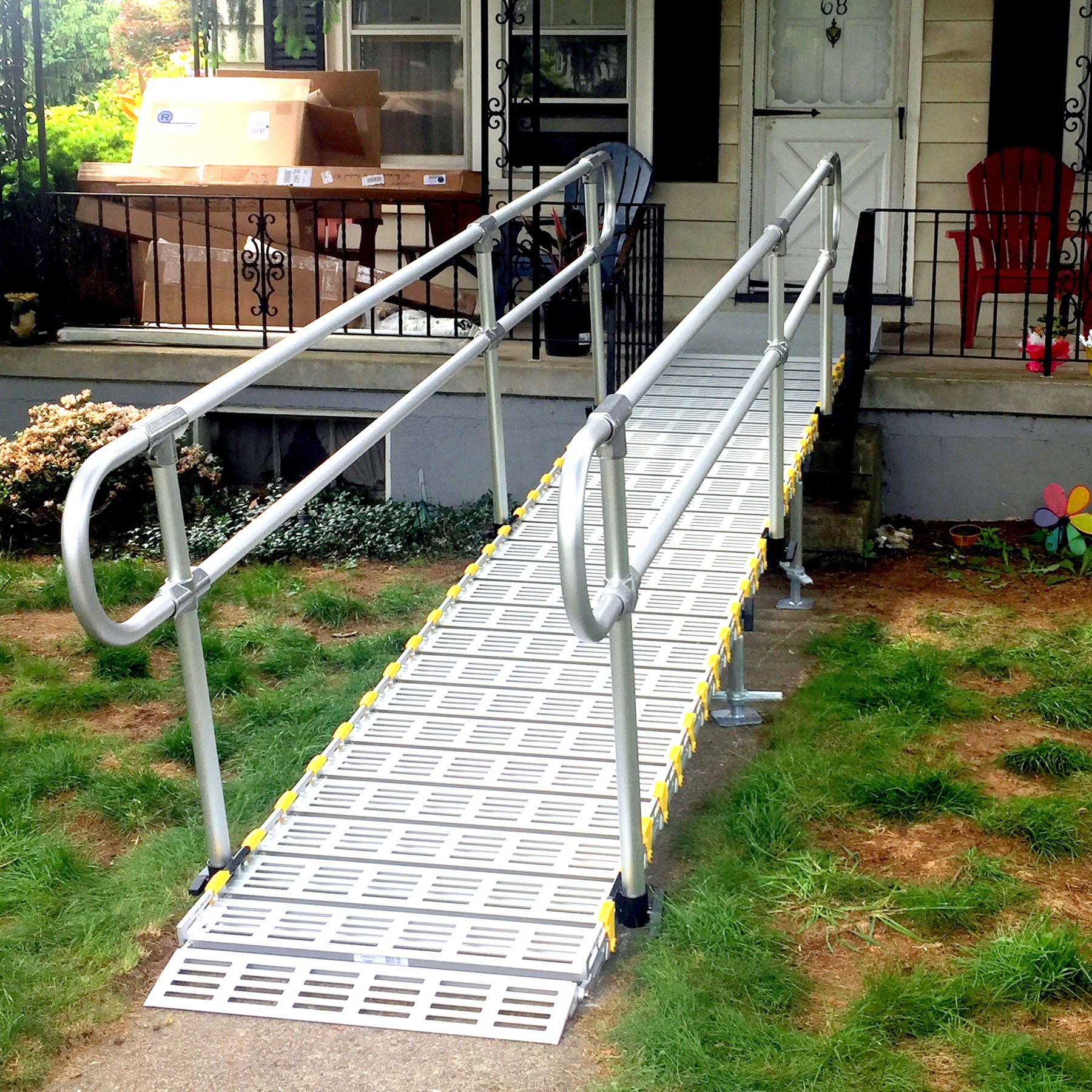
Roll-A-Ramp 36" Modular Ramp System | Portable Aluminum Roll-Up Ramp, 5' to 30'
In Stock Ships in 2-3 Business Days! (Estimated) View Product

Rampit USA United Series 48" Commercial Modular Ramp | 4' to 8' Lengths
Factory Direct Ships 2-4 Weeks! (Estimated) View Product
Rampit USA United Series 72" Wide Commercial Aluminum Ramp – Maximum-Width ADA Access System
Factory Direct Ships 2-4 Weeks! (Estimated) View ProductFrequently Asked Questions
Find answers to commonly asked questions below.
-
Can a modular wheelchair ramp fit a small front yard or an entrance with a turn?
Many modular systems offer straight, L-shaped, or switchback layouts using compatible platforms. These configurations can help accommodate a property where a straight ramp would not fit. Measure the available ground space, entrance height, door swing, and obstacles before selecting a layout. Limited space should not be addressed by making the ramp excessively steep.
-
What ramp width do I need for a wheelchair or mobility scooter?
Choose a ramp with enough usable clear width for your mobility device and safe maneuvering. Compare the device’s overall width with the space between the ramp’s rails or edges, rather than relying only on the advertised width. Also check turning space on platforms and any applicable accessibility requirements.
-
How much weight can a modular wheelchair ramp support?
Weight capacity varies by model, ramp length, and support configuration. Include the combined weight of the user, wheelchair or scooter, carried equipment, and anyone assisting on the ramp. Check the manufacturer’s rating for the complete installed system, including its platforms and supports, before ordering.
-
Are modular wheelchair ramps ADA compliant?
A modular ramp can form part of an ADA-compliant installation when its design and layout meet all applicable requirements. Compliance depends on slope, clear width, landings, handrails, edge protection, and other details. A product labeled “ADA compliant” does not guarantee that every installation meets those requirements.
-
Can I install a modular wheelchair ramp myself?
Some modular ramp systems allow assembly with basic tools, but installation requirements vary. Review the manufacturer’s instructions for ground preparation, supports, connections, and anchoring before starting. If the entrance has uneven ground, several turns, or a complex layout, have a qualified installer assess the site and confirm the setup.
-
Are aluminum modular wheelchair ramps suitable for outdoor use?
Outdoor-rated aluminum ramps are suitable for exterior entrances, but surface design and maintenance still matter. Open-mesh and textured surfaces can help with drainage or traction, depending on the model. No surface guarantees grip on ice. Keep the ramp clear of debris, snow, and ice, and follow the manufacturer’s cleaning and winter-care instructions.
-
Can I extend or reconfigure a modular wheelchair ramp later?
Many modular systems can be extended or rearranged using compatible sections and platforms. Before buying additional parts, confirm compatibility with the existing model and check whether extra supports or handrails are required. Any new layout must be reassessed for slope, stability, and landing space.
-
Will installing a modular ramp affect my home’s resale value or require permanent structural changes?
Many modular ramps can be disassembled, making them adaptable when access needs change. However, attachment methods, anchoring, and ground preparation depend on the model and site, so permanent changes cannot always be ruled out. The effect on resale value varies by property and buyer; no increase or decrease can be guaranteed.
-
When are handrails required or recommended for home wheelchair ramps?
Handrails play a crucial safety role on wheelchair ramps, especially in residential settings. For any ramp with a rise greater than 6 inches or a length longer than 6 feet, handrails are typically required by building codes and are always strongly advised for stability. Most modular systems are designed with full-length handrails included, making them suitable for longer or steeper installations. In contrast, smaller threshold and portable ramps, generally intended for short rises, often lack handrails and should be used only in applications where additional support isn’t necessary. To ensure easy and secure access for all users, always plan for handrails whenever the ramp exceeds the minimum rise or run, or when extra support may be needed for peace of mind.
-
How much does a home wheelchair ramp typically cost?
The cost of a home wheelchair ramp depends on the height you need to access, the ramp length, the style you choose, and the configuration, including platforms, handrails, and turns. Threshold ramps are typically used for a small step or doorway. Portable ramps are a flexible choice for steps or short distances. Modular aluminum ramps with handrails are the usual choice for longer rises and more permanent access. For a tailored quote, send your total rise, available run length, and entrance layout, or request a project quote.
-
How do modular, portable, threshold, and wood ramps compare?
When it comes to providing access, choosing the right ramp type matters. Here’s how they stack up: Modular Aluminum Ramps: Ideal for regular, everyday access at a porch, deck, or primary entrance. These bolt together from lightweight sections and stand on adjustable legs, no need to pour concrete. Handrails are included for safety, and since they’re modular, you can add onto them, change the layout, or even move them to another entrance if your needs change. Portable Ramps: Perfect for temporary situations like a short-term recovery, visiting family, or for renters who need non-permanent solutions. Portable ramps set up in minutes and can be removed just as quickly. They’re best for a few steps or shorter rises, and while they’re easy to handle, they usually don’t have handrails. Threshold Ramps: These are made for minor level changes, think doorway sills or small steps at sliding doors. Threshold ramps are compact and low-profile, designed for rises just a few inches high. They sit right in place and make it simple for wheelchairs or walkers to cross over smooth transitions. Wood Ramps: A go-to for custom-built accessibility. Wooden ramps are constructed on-site by a contractor, making it possible to tailor them for unusual layouts or aesthetics. However, they need regular sealing or painting to stand up to the weather and can get slick when wet, so a good grit surface is a must. Selecting the right ramp depends on how you’ll use it, the height you need to reach, and whether you want something permanent or flexible in the future.
-
Do you need a permit to install a modular wheelchair ramp at home?
Permit requirements for a home wheelchair ramp vary by city and county. In many locations, freestanding aluminum modular ramps (and some temporary ramps) can be installed without a permit, especially if they’re not permanently attached to your home’s structure. However, some areas will require a permit, particularly for larger installations, ramps anchored to your house, or those modifying entrances or exits. Before moving forward, check with your local building or permitting office to confirm current requirements. This quick step can help avoid headaches and ensure your ramp meets any safety or accessibility codes that apply.
-
Will Medicare or insurance cover a home wheelchair ramp?
Medicare typically does not pay for wheelchair ramps, since they’re classified as home modifications rather than durable medical equipment. However, options do exist for some homeowners. If you’re a veteran, VA home modification grants may help with ramp funding. State Medicaid waiver programs and local Area Agencies on Aging can sometimes offer financial support as well. Nonprofit organizations are another possible resource. Need to submit a request for insurance or a grant? Reach out to us for a detailed, itemized quote to include with your application.
-
Where can I find funding or assistance for a home wheelchair ramp?
Medicare typically does not cover wheelchair ramps for homes, since ramps are considered general home modifications. However, there are other resources that may help offset the cost: Veterans benefits: Veterans may qualify for assistance through VA home modification grants, including the Specially Adapted Housing (SAH) or Home Improvements and Structural Alterations (HISA) programs. Medicaid waiver programs: Many states offer Medicaid waivers that can help with accessibility modifications, including ramps. Check with your state Medicaid office to see if you qualify. State and local resources: Your local Area Agency on Aging may know of grants or low-interest loan programs for accessibility improvements. State-run assistive technology programs and disability services offices are also worth contacting. Nonprofit organizations: Groups like Rebuilding Together, the United Cerebral Palsy Foundation, and the ALS Association sometimes provide funding or volunteer labor for ramp installation. Fundraising and community grants: Crowdfunding platforms or local charitable foundations occasionally offer support for accessibility updates. If you need an itemized quote to submit to any of these organizations or programs, just let us know.
-
Are home wheelchair ramps required to be ADA compliant?
No, ADA requirements apply specifically to public and commercial properties, not private homes. However, using ADA guidelines when installing a ramp at home is strongly recommended. Planning for a 1:12 slope, aiming for at least a 36-inch clear width, including sturdy handrails on longer runs, and adding level landings all help make home ramps safer and more comfortable to use. These guidelines are designed for safety and usability, whether you’re an individual homeowner or planning access for a family member. Even though your home ramp doesn’t need to be officially ADA compliant, following the same principles can help ensure smooth, secure access for wheelchair users.
-
Are steel or aluminum wheelchair ramps better?
Aluminum is the most common choice for modular ramps because it does not rust, needs little maintenance, and is light enough to install and relocate in sections. Steel ramps are heavier and need coatings to resist corrosion outdoors. For most commercial and residential entrances, an aluminum modular system is the practical choice.