







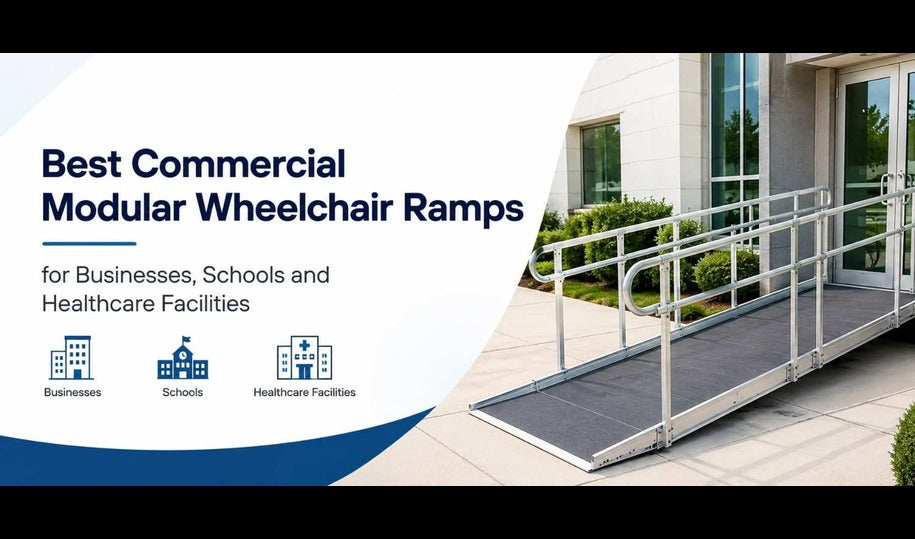
Commercial Modular Wheelchair Ramps: The Right Configuration for Every Facility
Businesses, schools, and healthcare facilities each face different access challenges. This guide matches your specific entrance scenario to the right modular ramp solution — and keeps you on the right side of ADA, IBC 2024, and Section 504.
Shop Commercial Ramps →Not every building has the same access problem. A retail store dealing with a 6-inch threshold has completely different needs than a school gymnasium entrance with a 24-inch rise, or a hospital wing that must handle bariatric power chairs in both directions. The ramp that works in one situation fails in another — and when accessibility is involved, failure is never just an inconvenience.
This guide covers what commercial modular wheelchair ramps look like in practice across three of the highest-need settings: businesses, schools, and healthcare facilities. If you've already read our ADA requirements guide for commercial buildings, consider this the next step — moving from legal specifications into what you actually need to order for your specific situation.
About the United Series: All configurations referenced in this guide are based on the United Series from Rampit USA, available through Rescue Supply. It carries ADA and IBC 2024 certification, is SAM.gov registered, and is purpose-built for the load and traffic demands of institutional settings. It's what the majority of our commercial buyers end up specifying.
What Makes a Modular Ramp "Commercial Grade"?
The term gets used loosely. A residential modular ramp and a commercial modular ramp can look nearly identical in a product photo. The differences show up under load, over time, and during inspections.
Rated to handle repeated daily use by multiple users, including power wheelchairs exceeding 400 lbs before factoring in the rider. The United Series is rated to 1,000 lbs — a specification that matters in high-traffic environments where several users may be on a ramp system at once.
This grade holds its structural integrity under sustained load without the flex that lower-grade aluminum develops over time. It won't rust, warp, or degrade — even in harsh northern climates.
Welds, handrail connections, and deck panel locking mechanisms on commercial systems are engineered for the cumulative stress of hundreds of users per week, not dozens per month.
Every United Series ramp is built domestically. For institutional buyers evaluating total cost of ownership, domestic manufacturing plus zero-maintenance aluminum construction typically results in significantly lower long-term costs than concrete or wood alternatives.
Government & Institutional Procurement: The United Series is registered on SAM.gov, allowing purchase through federal and state government channels without a separate vendor approval process. School districts, hospital networks, VA facilities, and municipal governments use this to streamline purchasing when compliance timelines are tight — in alignment with GSA guidance for accessibility equipment acquisitions.
Commercial Ramp Configuration Reference Table
Before getting into sector-specific scenarios, this table covers the most common rise heights and what they require. Facility managers and procurement teams use this as a starting point before measuring their specific entrance.
| Rise Height | Min. Ramp Length (1:12) | Recommended Width | Typical Configuration | Handrails Required |
|---|---|---|---|---|
| 3 in | 3 ft | 48 in | Straight run | Recommended |
| 6 in | 6 ft | 48 in | Straight run | Required above 6" |
| 9 in | 9 ft | 48 in | Straight run | Yes |
| 12 in | 12 ft | 48–54 in | Straight run | Yes |
| 18 in | 18 ft | 48–54 in | Straight run or L-turn | Yes |
| 24 in | 24 ft | 54–60 in | L-turn or switchback | Yes |
| 30 in | 30 ft | 54–60 in | Switchback | Yes |
| 36 in | 36 ft | 60–72 in | Switchback + intermediate landing | Yes |
Note on rises above 30 inches: These almost always require a switchback configuration in commercial settings because very few building entrances have 30+ feet of straight linear approach. A switchback turns the required run length into a more compact footprint by changing direction at an intermediate landing.
Three Settings, Three Distinct Challenges
Businesses
Retail stores and offices typically deal with 4–12" rises but face tight sidewalk footprints, lease restrictions, and peak-hour traffic pinch points. Modular systems solve all three.
Schools
Older buildings can have 18–36" entrance rises and serve users from small children to adult visitors. Title II ADA and Section 504 apply simultaneously — the compliance bar is higher.
Healthcare
Patients are often the most vulnerable wheelchair users. Non-compliant ramps create Joint Commission and CMS survey exposure — not just ADA risk — affecting accreditation and reimbursement.
Commercial Modular Wheelchair Ramps for Businesses
Retail Stores and Restaurants
Most retail and restaurant entrances deal with relatively modest rise heights — typically 4 to 12 inches. The compliance challenge isn't usually the ramp itself. It's the space constraints around it.
A 12-inch rise needs at least 12 feet of ramp at 1:12 slope. For a storefront with a narrow sidewalk, that run has to go somewhere. The United Series handles all of these layouts:
- Parallel to the building face — keeps the ramp within the existing sidewalk envelope
- Angled toward the parking lot — works when the approach direction naturally comes from the lot
- L-shaped with an intermediate landing — fits large rises into constrained footprints without sacrificing slope compliance
Top landing tip for retail: The ADA minimum of 60 inches at the top landing is a floor, not a target. 72 inches gives meaningful real-world clearance and prevents a bottleneck during peak hours when customers arrive with bags, strollers, and carts alongside wheelchairs.
Leasing a space? Modular systems address the permanent-modification concern directly — they anchor without concrete, leave no permanent footprint, and can be removed when a lease ends. Most commercial landlords have no objection. The ADA National Network confirms that modular ramp installation is generally considered a reasonable modification under Title III even in leased commercial spaces.
Office Buildings and Professional Suites
Multi-tenant office buildings present a layered scenario: the primary accessible entrance handles the ground floor, but tenants in spaces with interior elevation changes need solutions inside as well. A raised reception area or split-level suite creates the same access problem indoors that a stepped entrance creates outside.
- Transition plates — Beveled threshold plates at the top and bottom of every run prevent trip hazards at the floor interface. The United Series includes these as a standard component, no custom fabrication required.
- Surface consistency — Indoor installations require careful attention to how the ramp integrates with surrounding flooring materials.
- Client-facing compliance — For medical practices, law firms, and financial offices, ADA compliance is also a client-facing concern. A patient who can't reach the reception desk without assistance is a patient who may not return. The ramp is part of the practice environment and should look like it belongs there.
Commercial Modular Wheelchair Ramps for Schools
Schools present some of the most demanding ramp scenarios in any commercial setting. The user population spans children in manual chairs to adults in heavy power chairs, traffic volume during passing periods can be intense, and schools are held to both Title II ADA requirements and Section 504 of the Rehabilitation Act simultaneously — meaning the compliance standard is effectively higher than for private businesses.
Entrance and Exterior Applications
Older school buildings frequently have main entrances with significant rise heights — 18 to 36 inches is common in buildings constructed before accessible design was standard practice. A 36-inch rise requires:
- A minimum 36-foot ramp run at 1:12
- Either a very long straight run, or a switchback configuration with a 60×60-inch intermediate landing
High-traffic school entrance tip: The minimum 60-inch landing is sufficient for compliance, but 72-inch or wider platform sections are worth the added cost on busy school entrances — they allow students to pass each other on the landing without stopping, keeping traffic moving during transitions.
Gymnasium and Auditorium Access
Gym floors sit elevated above the surrounding corridor in many school buildings, typically 8 to 18 inches. These spaces serve not just students during the school day but the broader community during evening events — meaning:
- Accessibility requirements extend beyond school hours
- A ramp serving a gym entrance must accommodate the full range of users, including adult visitors who haven't disclosed mobility needs in advance
Auditoriums present a related issue. Fixed seating areas often have multiple tier levels, and U.S. Department of Justice ADA guidance on assembly areas specifically requires that accessible seating be integrated throughout the venue, not concentrated in a single location. Modular ramp sections connecting tier transitions are a practical solution in older auditoriums not built with ramped aisles.
Portable Classrooms
Portable classrooms are one of the most persistent accessibility problems in American schools. They sit elevated on foundations with entrance rises of 24 to 36 inches — and they move. Whatever ramp solution gets installed needs to move with them.
Modular ramps are the standard solution for portable classroom access because they're designed to be reconfigured. A system installed at one portable can be broken down and reassembled when the classroom relocates. Concrete is simply not a practical option here.
Still using wooden ramps on portable classrooms? That's both a compliance risk and an ongoing maintenance cost. A modular aluminum system eliminates both over any reasonable time horizon.
Commercial Modular Wheelchair Ramps for Healthcare Facilities
Healthcare facilities operate under more scrutiny than any other commercial setting. Patients and residents are often the most vulnerable wheelchair users: post-surgical, elderly, bariatric, or managing degenerative conditions. Design choices that are marginal in a retail context become genuinely consequential in a clinical one.
Beyond ADA exposure: The Joint Commission and CMS both include physical accessibility in their facility survey criteria. A non-compliant ramp at a healthcare facility is a potential survey finding that can affect accreditation and reimbursement — not just a legal liability.
Clinics and Medical Offices
Outpatient clinics serve patients who are recovering, managing chronic conditions, or presenting with new mobility limitations. For many, the entrance ramp is the first and last physical interaction with the facility on every visit. Two design choices that seem minor but aren't:
- A 1:12 slope when a 1:16 was achievable — the gentler slope is meaningfully easier for manual chair users and elderly patients
- A landing that's exactly 60 inches when 72 would have been possible — the extra clearance directly reduces exertion for manual chair users making a three-point turn
Medical facilities serving high bariatric patient volumes should confirm specific load ratings before purchasing. The United Series at 1,000 lbs accommodates most situations, but verify in writing with the manufacturer if your patient population has particular requirements.
Hospitals and Long-Term Care Facilities
Hospitals and skilled nursing facilities deal with ramp scenarios across an entire campus — exterior entrances, loading docks used for patient transport, connections between buildings at different grade levels, and internal transitions between departments. Addressing them with a consistent certified system simplifies both maintenance and compliance documentation across the facility.
- Open-drain deck design on the United Series handles rain and snowmelt without surface pooling
- Heated deck panels are available for exterior ramps in northern climates — worth discussing with your facilities team during specification
- SAM.gov registration removes a purchasing step for hospital networks and VA facilities procuring through government channels
Rehabilitation Centers
Rehab facilities occupy a distinct category: the ramp is sometimes part of the therapeutic environment itself. Patients relearning to navigate mobility aids use facility ramps as part of their recovery program. Ramp design here is both clinical and compliance-driven.
Consistent grip throughout the facility ensures patients encounter the same tactile environment on every ramp section during rehabilitation exercises.
Uninterrupted support across all runs — critical for patients building upper-body strength and confidence during recovery.
Predictable resistance across every installed section allows therapists to accurately track patient progress over time.
The United Series uses the same deck panel geometry and handrail configuration across all widths — a patient practicing on one ramp encounters the identical physical environment on another.
Choosing the Right Configuration for Your Facility
The selection process comes down to four measurements and one decision.
The Four Measurements You Need Before Ordering
The vertical height from ground level to the door sill. This single number drives ramp length, configuration type, and whether a switchback is needed.
The linear distance you have in the direction of travel. If this is shorter than your minimum ramp length, an L-turn or switchback is required.
Affects landing placement, approach angle, and whether users can safely open the door from a chair without rolling backward on the ramp.
Determines width, load rating confirmation, and whether wider landing sections are worth the additional cost for your specific setting.
Straight Run, L-Turn, or Switchback?
- Straight run — If your footprint is long enough for a straight run at 1:12, use it. Simplest to install and navigate.
- L-turn — Changes direction at a landing to fit the same rise into a shorter footprint. Common in constrained sidewalk scenarios.
- Switchback — For rises over 24 inches, this is almost always the answer in commercial settings. Very few building entrances have more than 24 feet of straight linear approach from the door.
The United Series product pages include configuration guides for common rise heights and entrance types. For non-standard entrances with unusual angles, constrained landing areas, or specific footprint limitations, Rescue Supply's team can provide a CAD layout before you purchase so you know exactly what you're getting before anything ships. Submit custom layout requests to ramps@rescue-supply.com.
Shop Commercial Modular Wheelchair Ramps at Rescue Supply
Rescue Supply carries the full United Series lineup for commercial, institutional, and healthcare applications. Every system ships ready to install with everything shown below included.
For institutional bids, Rescue Supply offers aggressive price matching on identical items from authorized dealers. Custom layout requests and CAD designs can be submitted to ramps@rescue-supply.com.
Ready to Specify the Right Ramp for Your Facility?
Browse the full United Series lineup or submit a custom layout request — our team provides CAD designs before anything ships, so there are no surprises on delivery day.
Browse Commercial Ramps View All Modular Ramps