










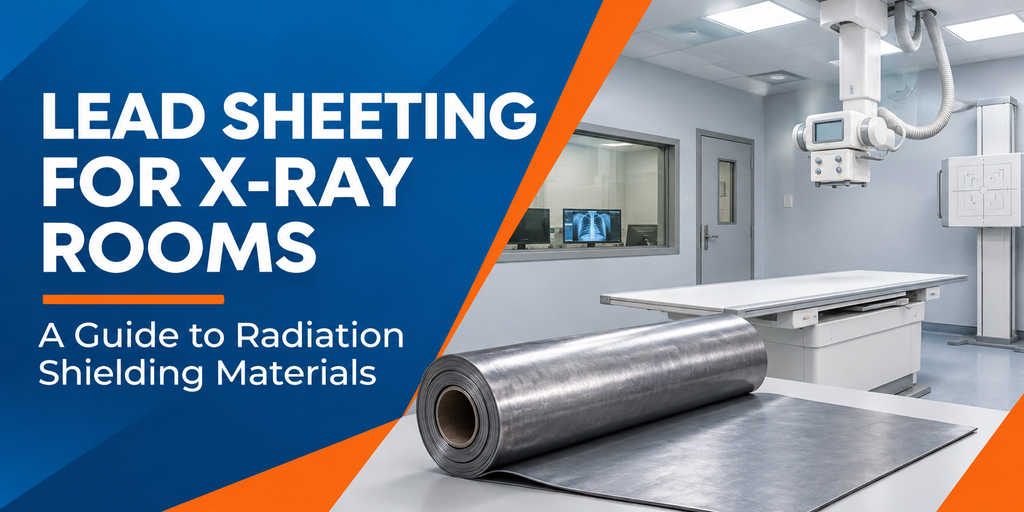
When planning an X-ray room, medical imaging suite, or diagnostic facility, radiation protection needs to be considered from the beginning of the building design process. One material frequently incorporated into structural radiation shielding systems is lead sheeting.
Because of its high density and ability to attenuate X-ray radiation, lead is commonly used in protective barriers designed for medical and industrial imaging environments. When properly specified and installed as part of an engineered shielding system, lead sheeting can help reduce radiation transmission into surrounding occupied areas.
For hospitals, imaging centers, dental clinics, veterinary practices, contractors, and facility managers, understanding the material, available thicknesses, installation considerations, and project requirements is important when sourcing radiation shielding materials.

- What lead sheeting is and how it works in radiation shielding.
- Where lead sheets are used in X-ray room construction.
- What determines the required lead thickness.
- Available Phillips Safety lead sheet thicknesses and dimensions.
- Important installation and purchasing considerations.
1. What Is Lead Sheeting?
Lead sheeting is a flat, flexible sheet manufactured from lead metal. It is used in applications requiring a dense material barrier, including radiation shielding, acoustic control assemblies, industrial gasketing, packing, sealing, and protective lining.
Lead is particularly useful in X-ray shielding because it has a high atomic number and density. These material properties allow it to attenuate X-ray photons as they pass through an appropriately designed barrier.
In building construction, lead sheets can be incorporated into different assemblies, depending on the project's shielding requirements.

Radiation Shielding
Used within designated walls, doors, partitions, and equipment enclosures to reduce X-ray transmission.
Acoustic Applications
Used as a component in acoustic control assemblies where dense barrier materials are required.
Industrial Gasketing
Can be incorporated into certain packing, sealing, and gasketing applications.
Protective Lining
Used in selected tank and container lining applications, subject to material compatibility.
2. Why Is Lead Sheeting Used in X-Ray Rooms?
Medical X-ray equipment uses ionizing radiation to create diagnostic images. Although these imaging technologies are essential in healthcare, facilities must implement appropriate radiation protection measures for workers, patients, and members of the public.
Structural shielding is one part of a facility's radiation protection program. Lead sheeting can be incorporated into building barriers to attenuate radiation traveling toward adjacent spaces.
Common Applications of Lead Shielding
- X-ray room walls: Lead can be incorporated into designated wall assemblies.
- Radiation-shielded doors: Lead lining may be specified for doors and compatible frames.
- Protective partitions: Lead-lined partitions can provide shielding between designated areas.
- Dental imaging facilities: Lead may be incorporated into shielding assemblies for dental X-ray rooms.
- Medical imaging suites: Different shielding configurations may be required depending on the imaging equipment.
- Industrial imaging facilities: Specialized shielding designs may be required for industrial radiography applications.
Lead sheeting alone does not automatically make a room radiation-safe. The complete shielding assembly must be designed around the equipment, operating conditions, room layout, and surrounding occupancy. A qualified radiation shielding professional should determine the required materials and specifications.
3. How Thick Should Lead Sheeting Be for an X-Ray Room?
One of the most common questions during an X-ray room construction or renovation project is how thick the lead shielding should be.
There is no single lead thickness that is appropriate for every X-ray room. The required thickness must be calculated based on the specific imaging equipment and facility conditions.
Factors That Influence Shielding Requirements
- X-ray equipment specifications: The type of imaging equipment, operating tube voltage, exposure characteristics, and intended procedures influence the shielding calculation.
- Equipment workload: The frequency and volume of imaging procedures affect the amount of radiation generated over time.
- Room layout and equipment positioning: The location of the X-ray source, patient, walls, doors, and adjacent spaces must be considered.
- Occupancy of surrounding areas: Areas regularly occupied by staff or members of the public may require different shielding considerations.
- Primary and secondary barriers: Primary barriers are designed to attenuate the useful X-ray beam, while secondary barriers address scattered and leakage radiation.
- Applicable regulations: Local radiation safety regulations and the project's shielding design goals must be considered.
Obtain the approved shielding specifications from the project's qualified medical physicist or health physicist. Do not select lead thickness based solely on an online chart, another facility's installation, or a general recommendation.
4. Available Phillips Safety Lead Sheeting Thicknesses
Phillips Safety offers lead sheeting in multiple thicknesses and dimensions for different material and project requirements.
The product specifications listed by the manufacturer include five thickness options:
| Lead Sheet Thickness | Approximate Metric Thickness |
|---|---|
| 1/64 inch | 0.40 mm |
| 1/32 inch | 0.79 mm |
| 1/16 inch | 1.59 mm |
| 3/32 inch | 2.38 mm |
| 1/8 inch | 3.18 mm |
These are nominal material thickness conversions, not recommended X-ray room shielding specifications. The required lead equivalency must be established by the approved shielding design.
Available Sheet Dimensions
Phillips Safety lists a range of sheet dimensions, including:
- 12" × 12"
- 12" × 24"
- 24" × 24"
- 24" × 36"
- 24" × 48"
- 36" × 48"
- 48" × 48"
- 48" × 96"
Not every dimension is necessarily offered in every thickness. Confirm the exact size, thickness, and current product availability before placing an order.
Material Specifications
According to the Phillips Safety product information, its lead sheeting meets Federal Specification QQ-L-201F Grade B and contains a minimum of 99.5% lead (Pb).
These material specifications provide useful purchasing and documentation information. However, material compliance by itself does not establish that a particular sheet thickness will satisfy an X-ray room's shielding requirements.
5. How Is Lead Sheeting Installed in Radiation Shielding Applications?
Lead sheeting is generally incorporated into a larger building assembly rather than used as a standalone room covering. Depending on the approved shielding design, it may be installed inside wall systems, doors, partitions, and other designated structural barriers.

Important Installation Considerations
- Continuous shielding: Joints, seams, corners, and transitions between shielding materials must be addressed to maintain the required barrier protection.
- Wall and door openings: Electrical outlets, plumbing, HVAC penetrations, door frames, and other openings must be incorporated into the shielding design.
- Structural support: Lead is a dense and relatively heavy material. The supporting structure and installation method must account for its weight.
- Material compatibility: Adhesives, fasteners, substrates, and other building materials must be suitable for the intended installation.
- Installation verification: The completed shielding assembly should be evaluated by qualified personnel in accordance with applicable project requirements.
Overlaps, joint treatments, fastening methods, and penetration details should follow the approved shielding drawings and applicable requirements. A qualified professional should review the installation rather than relying on generic dimensions found online.
6. What Should You Consider When Buying Lead Sheeting?
Selecting the right lead sheeting involves more than choosing a thickness or sheet size. Procurement teams should verify that the selected material matches the project's approved technical specifications.
-
Confirm the Required Lead Thickness
Obtain the required lead thickness or lead equivalency from the approved shielding report.
-
Review Manufacturer Specifications
Check the material grade, composition, nominal thickness, and available supporting documentation.
-
Determine Sheet Dimensions and Quantities
Calculate the coverage requirements and account for the specified joint and installation details.
-
Consider Shipping and Handling
Lead sheets are heavy. Larger orders and full-size sheets may require specialized packaging, freight arrangements, and appropriate receiving procedures.
-
Request Technical Documentation
Ask for available manufacturer specifications, certificates, and supporting documents required for project review.
7. Phillips Safety Lead Sheeting from Rescue Supply
Rescue Supply offers Phillips Safety Lead Sheeting for customers sourcing lead materials for medical, commercial, construction, and industrial applications.
With multiple thickness and sheet size options listed, Phillips Safety lead sheeting provides procurement teams with different material configurations to review against their project specifications.
Product Highlights
- Five listed nominal thickness options from 1/64" to 1/8".
- Multiple sheet dimensions, including larger 48" × 96" sheets.
- Manufacturer-listed QQ-L-201F Grade B material specification.
- Minimum 99.5% lead content as stated by Phillips Safety.
- Applications that include radiation shielding and selected industrial uses.
- Options for individual purchases and larger project requirements.
8. Lead Safety and Material Handling
Although lead is useful in radiation shielding applications, it is also a hazardous material that requires appropriate handling precautions.
Lead exposure can occur through inhalation of lead-containing dust or fumes and through ingestion of contaminated particles. Cutting, drilling, grinding, or otherwise disturbing lead materials can create exposure risks if appropriate controls are not implemented.
Facilities, contractors, and installers should follow applicable occupational safety requirements when receiving, storing, cutting, handling, and installing lead sheeting.
For additional guidance, consult OSHA's lead safety resources and applicable workplace requirements.
Final Thoughts: Choosing the Right Lead Shielding Material
Lead sheeting plays an important role in many structural radiation shielding applications. However, selecting the right material requires careful consideration of the imaging equipment, project specifications, building design, and applicable radiation safety requirements.
For hospitals, dental offices, imaging centers, contractors, and industrial facilities, starting with an approved shielding design and verifying the manufacturer's material specifications can help make the procurement process more straightforward.
If your project requires lead sheets for radiation shielding or other industrial applications, Rescue Supply offers access to Phillips Safety lead sheeting in multiple listed configurations.
Find the Right Lead Sheeting for Your Project
Source Phillips Safety lead sheeting through Rescue Supply. Explore available thicknesses and sheet sizes for your medical facility, imaging center, construction project, or industrial application.