







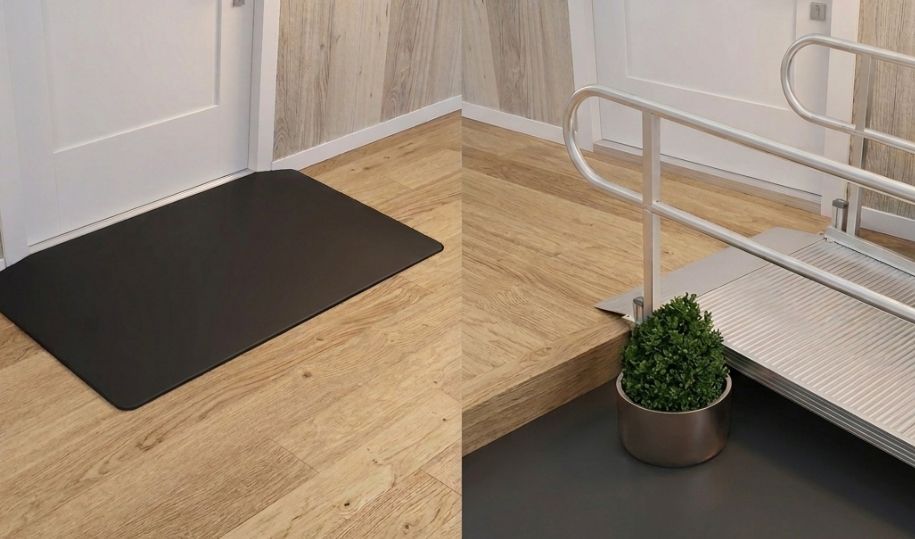
The Critical Difference: When navigating vertical obstacles, the vertical rise determines your equipment needs. Threshold ramps handle small lips under 6 inches, while modular ramps (like Rampit and Roll-A-Ramp) provide the structural integrity required for porches and decks while meeting strict ADA safety guidelines.
Deep Dive: Modular vs. Threshold Accessibility
In the medical equipment industry, selecting the wrong ramp isn't just an inconvenience it's a safety liability. Choosing between a threshold plate and a modular system requires an understanding of weight capacity, slope ratios, and the specific mobility device in use.
1. Threshold Ramps
Precision-engineered for "micro-transitions." These are typically single-piece plates or rubber wedges designed to bridge the "lip" of a doorway or a single-step curb.
- Rise Range: 0.5" to 6" maximum.
- Portability: High. Often moved between different doorways.
- Best For: Shower entries, sliding glass door tracks, and raised interior flooring.
2. Modular Ramps
Comprehensive, sectional systems designed for significant vertical rise. These systems are the standard for any transition exceeding a single step.
- Rise Range: 6" to multi-story heights.
- Ratio: Strictly follows the ADA 1:12 slope requirement.
- Best For: Front porch access, hospital entrances, and commercial facilities.
Technical Specifications Comparison
| Feature | Threshold Ramp | Modular Ramp (Rampit/Roll-A-Ramp) |
|---|---|---|
| Weight Capacity | Up to 800 lbs | 1,000 lbs+ (Bariatric Rated) |
| Material | Rubber or Light Aluminum | Aircraft Grade Aluminum |
| Installation | Zero Tools / Instant | Bolt-Together / Semi-Permanent |
| Safety Rails | Optional / Rare | Mandatory Dual-Height Handrails |
The 1:12 ADA Rule: Why It Matters
For any ramp used in a professional or public setting, the 1:12 ADA Slope Ratio is the law. This means for every 1 inch of vertical rise, you must have 12 inches (1 foot) of ramp length. While a threshold ramp might sit flush against a door, a 24-inch porch rise requires a 24-foot modular system with resting platforms to ensure a safe, manageable incline for manual or power chairs.
Durability and Long-Term Value
Investing in Rampit or Roll-A-Ramp systems ensures your facility remains accessible through all seasons. Unlike wooden ramps that rot or steel ramps that rust, high-grade aluminum offers a self-draining, high-traction surface. These systems are also "moveable assets" they can be disassembled, reconfigured, or relocated as your facility evolves.
Final Verdict: Selecting Your Solution
Choosing the right ramp comes down to a single measurement: The Vertical Rise. If you are bridging a small doorway lip to prevent a trip hazard, a threshold ramp is your fastest and most cost-effective solution. However, for any elevation that requires a sustained incline or must support heavy power chairs, a modular aluminum system is the only way to ensure 100% ADA compliance and user safety.
Always remember to measure your total rise twice and consult with a professional to ensure your ramp length provides a safe, comfortable grade for all mobility device users.