








Most facility managers don't think about ramp compliance until something goes wrong—a complaint gets filed, an inspector visits, or a customer in a wheelchair simply can't get through the front door. At that point, the 1:12 slope ratio you meant to look up three months ago suddenly becomes urgent.
This guide covers what the ADA actually requires for commercial ramps in 2026, where buildings most commonly get it wrong, and why modular aluminum systems have become the go-to fix for most commercial properties.
A Note on the Law: ADA Enforcement
The Americans with Disabilities Act (ADA) is a federal civil rights law, not just a building code. This distinction is critical because enforcement doesn't only come from city inspectors—it can be triggered by complaints from customers, employees, or advocacy organizations.
ADA Ramp Slope Requirements: The 1:12 Ratio
The 1:12 ratio is the foundation of compliance. For each inch of vertical rise, the ramp must run at least 12 horizontal inches.
- 6-inch rise: Requires at least 6 feet of ramp.
- 20-inch rise: Requires at least 20 feet of ramp.
While 1:12 is the maximum allowable slope for new construction, a gentler slope (1:16 or 1:20) is highly recommended to improve accessibility for manual wheelchair users. Note that existing buildings have limited flexibility in tight spaces (1:10 or 1:8) only for very small rises (under 6 inches), but these should be considered absolute last resorts.
Critical Specifications for Commercial Ramps
Width Requirements
The absolute minimum width is 36 inches, but 48 inches is the commercial standard. A 48-inch width comfortably accommodates power chairs, bariatric users, and assisted passage. Models like the Rampit USA United Series offer widths up to 72 inches to suit high-traffic retail or medical entrances.
Landings and Runs
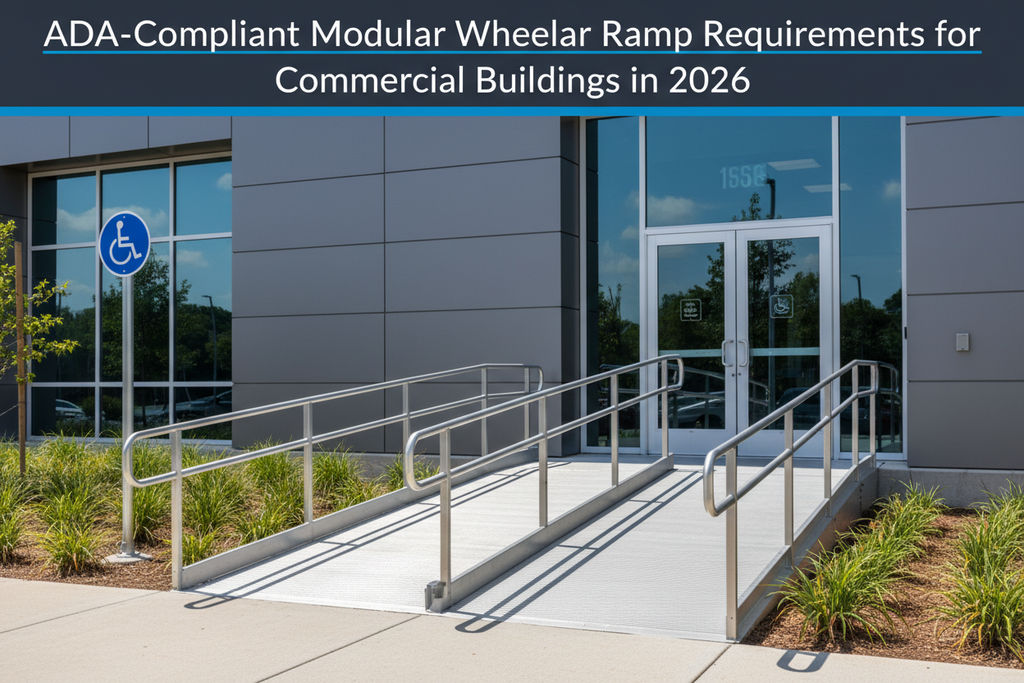
A single ramp run cannot exceed 30 feet without a level landing. Landings must be at least 60 inches long in the direction of travel. The top landing is the most frequent point of failure; without a flat space at the threshold, a user cannot safely stop to open the door.
Handrails and Safety
Handrails are required on both sides if the rise exceeds 6 inches. They must sit 34–38 inches above the ramp surface and extend 12 inches horizontally past the top and bottom of the ramp run. Pre-engineered modular systems often eliminate field errors by factory-setting these dimensions.
Why Modular Aluminum is the Industry Standard
Poured concrete is often prohibitively expensive, time-consuming, and permanent. Modular aluminum systems offer a superior alternative for the modern facility manager:
- Pre-Engineered Compliance: Components arrive factory-set to ADA/IBC specifications.
- Rapid Deployment: Most systems are fully installed in a single day.
- Permitting Ease: Modular designs often bypass the extensive permitting required for permanent concrete structures.
- Flexibility: They can be relocated or reconfigured if your business entrance changes.
- Zero Maintenance: Unlike wood or concrete, aluminum does not rot, crack, or require sealing.
Expert Support at Rescue Supply
We carry the full United Series lineup from Rampit USA. These systems are 100% ADA and IBC 2024 compliant, constructed from 6005-T5 aluminum, and are SAM.gov registered for institutional procurement. If you need help with site configuration, rise calculations, or CAD designs for complex layouts, our team is ready to assist.


