



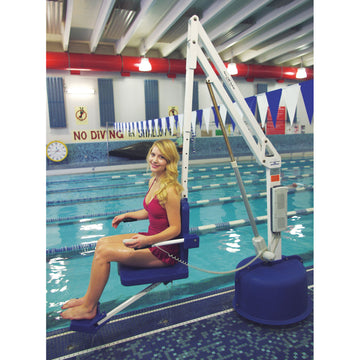


Before 2010, the federal ADA rules had no specific requirements for swimming pools. That changed with the 2010 ADA Standards for Accessible Design, which for the first time set out how people with disabilities have to be able to get into and out of pools, wading pools and spas. A pool lift is one of only two options the Standards accept as the main way into a regular swimming pool. The other is a sloped entry.
This guide is for the people who actually have to sort this out: hotel managers, parks and rec staff, school and university facilities teams, and HOA boards. We'll go through when a lift is required, how many accessible entries a pool needs, and the lift specs in section 1009.2, with links to the source for each one.
- 300 ftPool wall length that triggers a second means of entry (§242.2)
- 48 inDeepest water allowed at the lift location (§1009.2.1)
- 16 to 19 inSeat height in the raised position (§1009.2.4)
- 300 lbMinimum lifting capacity, single person lift (§1009.2.9)
Who has to follow the ADA pool rules?
Two parts of the ADA matter here. Title II covers state and local governments, so city pools, county aquatic centers and public school pools fall under it. Title III covers businesses open to the public. The Department of Justice names hotels and motels, health clubs, recreation centers and public country clubs as examples in its pool questions and answers.
Timing depends on whether the pool is new or existing. New and altered pools have had to meet the 2010 Standards since March 15, 2012. For existing pools, DOJ pushed the compliance date for accessible entry and exit to January 31, 2013. Existing pools at businesses have to be made accessible only when that's "readily achievable," which DOJ describes as easily accomplishable without much difficulty or expense. That's a case by case call, and DOJ says it's an ongoing obligation, so the answer can change from year to year.
How many accessible means of entry does a pool need?
The answer depends on the type of pool and, for regular swimming pools, how much pool wall there is. Section 242 sets it out:
| Pool type | Means of entry required | What counts |
|---|---|---|
| Swimming pool with less than 300 linear feet of wall | 1 | Pool lift or sloped entry |
| Swimming pool with 300 linear feet of wall or more | 2 | At least one pool lift or sloped entry. The second can be a lift, sloped entry, transfer wall, transfer system or pool stairs. |
| Wave pools, lazy rivers, sand bottom pools and others with entry limited to one area | 1 | Pool lift, sloped entry or transfer system |
| Wading pool | 1 | Sloped entry |
| Spa | 1 | Pool lift, transfer wall or transfer system. In a cluster, 5 percent but no fewer than one spa in each cluster. |
| Catch pool at the bottom of a slide | None | An accessible route has to reach the pool edge |
When you measure pool wall, count all of it. The advisory for §242.2 says walls at diving areas and stretches where nobody can enter because of landscaping or nearby structures still count toward the total. If you do have two means of entry, the same advisory recommends making them different types and putting them in different spots around the pool.
Measure the full perimeter before you buy. A pool that looks small can land right around 300 feet once you include the deep end. A rectangle that's 100 feet by 50 feet, for example, already has 300 linear feet of wall.
ADA pool lift specifications (section 1009.2)
A lift only counts as an accessible means of entry if it meets the technical rules in §1009.2. Here's the list we'd hold up against any spec sheet:
- Location. Put the lift where the water is no deeper than 48 inches. That doesn't apply if the whole pool is deeper than 48 inches, and if you have several lifts, only one has to be in water 48 inches deep or less (§1009.2.1).
- Seat location. In the raised position, the centerline of the seat sits over the deck at least 16 inches from the pool edge, and the deck between them can't slope more than 1:48 (§1009.2.2).
- Clear deck space. On the side of the seat away from the water, leave a space at least 36 inches wide that runs forward at least 48 inches from a line 12 inches behind the back of the seat. Slope there is 1:48 at most (§1009.2.3).
- Seat height. The lift has to be able to stop with the top of the seat 16 to 19 inches above the deck in the raised (load) position (§1009.2.4).
- Seat width. 16 inches minimum (§1009.2.5). The advisory notes that seats with backs work for more people.
- Footrests and armrests. Footrests are required and have to move with the seat. If there's an armrest on the side opposite the water, it has to come off or fold clear when the seat is raised (§1009.2.6).
- Operation. The rider must be able to run the lift without help from both the deck and the water. Controls can't be blocked and must work with one hand, without tight grasping, pinching or twisting, at 5 pounds of force or less (§1009.2.7 and §309.4).
- Submerged depth. The seat has to go down to at least 18 inches below the stationary water level (§1009.2.8).
- Lifting capacity. Single person lifts need a rated capacity of at least 300 pounds and have to sustain a static load of at least one and a half times the rated load (§1009.2.9).
The operation rule matters more than people expect. The advisory for §1009.2.7 explains that a swimmer who's alone has to be able to call the lift back when it's sitting up on the deck, so they aren't stuck in the water waiting for someone. Being independently operable doesn't stop staff from helping when a guest asks.
Fixed vs. portable lifts, and keeping a lift ready
DOJ says the real question isn't portable versus fixed. It's fixed versus non-fixed. A fixed lift is attached to the deck or apron in some way, so a portable lift that's anchored to the deck counts as fixed. The 2010 Standards expect lifts to be fixed. At an existing pool, if a fixed lift isn't readily achievable, DOJ says a business may use a non-fixed lift that otherwise meets the Standards. Generally, lifts bought after March 15, 2012 have to be fixed if it's readily achievable to do so.
The day to day rules trip up more facilities than the specs do:
- The lift has to stay in place and working whenever the pool is open. Storing it and bringing it out on request isn't allowed.
- When the pool is closed for the night or the season, you can take the lift out and store it.
- Sharing one non-fixed lift between two pools is risky. DOJ points out that a swimmer could be left with no way out if the lift gets moved.
- Battery lifts need charging. DOJ says staff should know how the lift works, where it is, and who's responsible for keeping it charged.
Spa and hot tub requirements
Every spa needs at least one accessible means of entry: a pool lift, a transfer wall or a transfer system (§242.4). If your spas are grouped together, 5 percent of them, and no fewer than one in each cluster, have to be accessible. Lifts used at spas don't have to have footrests, but the Access Board's guide to pools and spas encourages footrests or retractable leg supports, especially in larger spas with water 34 inches deep or more. For new construction, DOJ says each pool and spa needs its own accessible entry.
How the rules apply to hotels, city pools and HOAs
Hotels and motels
These are Title III public accommodations. New or altered pools need compliant entry. For existing pools, the readily achievable test applies. DOJ also says insurance rates or coverage limits aren't a valid reason to skip compliance, and a lift on back order doesn't mean you have to close the pool. DOJ adds that IRS Section 44 and Section 190 tax benefits can help businesses with access costs, so ask your tax advisor.
Municipal pools
Cities and counties fall under Title II "program accessibility." According to ADA.gov, not every pool has to be accessible, but a public entity with only one pool must make its swim program there accessible. Any equipment it buys, like a portable lift, should include the 2010 features, including independent operation.
HOAs and community pools
DOJ says pools limited to residents and their guests aren't covered by the ADA accessibility requirements. If the community rents the pool or opens it to the public, it's covered under Title III. A community pool owned or operated by a local government is covered by Title II.
Picking a pool lift
Start with the pool, not the catalog. Note the water depth where the lift would go, measure the deck space on the dry side of the seat, and find out whether the deck can take an anchor. Then compare spec sheets line by line against the nine items above. Our ADA pool lift chairs collection lists pool and spa lifts side by side so you can compare them. Models such as the Aqua Creek Mighty 400 and the portable Aqua Creek Mighty Voyager are listed as ADA compliant on their product pages. Still, check the manufacturer's spec sheet and anchoring options against your pool before you order.
Home pools are a different story. The ADA National Network says the ADA doesn't cover strictly residential private homes, so families can pick whatever lift suits the person using it.
Printable ADA pool lift checklist
Survey the pool
- Title II, Title III, or residents only?
- Total pool wall measured, deep end included
- One or two means of entry needed
- Spas counted, clusters noted
- Lift spot has water 48 in deep or less
- Accessible route reaches the lift
Check the lift
- Seat centerline 16 in or more from pool edge
- 36 by 48 in clear deck space, 1:48 max slope
- Seat stops 16 to 19 in above deck
- Seat 16 in wide or more, footrests move with it
- Works unassisted from deck and water
- Seat goes 18 in below water level
- 300 lb capacity or more
Daily operation
- Lift anchored to the deck, if readily achievable
- In place and working whenever the pool is open
- Battery charging assigned to someone
- Staff trained to run and maintain it
- Plan written down for any pool not yet accessible
ADA pool lift FAQ
Does every hotel pool need a pool lift?
A new or altered hotel pool needs at least one accessible means of entry, and for a pool with less than 300 feet of wall that has to be a lift or a sloped entry. For an existing pool, DOJ requires access when it's readily achievable.
Can we use a portable pool lift?
DOJ treats a portable lift that's attached to the deck as a fixed lift. A non-fixed lift may be used at an existing pool when a fixed lift isn't readily achievable, as long as it meets the 2010 specs and stays in place and working whenever the pool is open.
Does our HOA pool need a pool lift?
If the pool is only for residents and their guests, DOJ says the ADA accessibility requirements don't cover it. If the association rents it out or opens it to the public, Title III applies. Confirm with your local authority and the association's attorney.
Do spas and hot tubs need a lift?
Each spa needs one accessible means of entry, which can be a pool lift, a transfer wall or a transfer system. Where spas are clustered, 5 percent but no fewer than one in each cluster must be accessible. Footrests aren't required on spa lifts.
What weight capacity does an ADA pool lift need?
A single person lift needs a rated capacity of at least 300 pounds, and it has to sustain a static load of at least one and a half times that rating (§1009.2.9).
This guide is general information, not legal advice. Your state or local code may add requirements, so confirm with your local authority having jurisdiction. For ADA questions you can also call the DOJ ADA Information Line at 800-514-0301 (voice) or 833-610-1264 (TTY).
Tell us the pool type, the water depth where the lift will go and how much deck space you have, and we'll help you compare models against the 2010 specs. Call 800-239-1797 or browse the collection.
Shop ADA Pool LiftsCall 800-239-1797