






A workplace first aid kit is easy to buy and easy to forget. The real question is whether employees can reach it quickly—and whether the supplies inside are usable and appropriate for the injuries your workplace could face.
This guide explains OSHA’s first aid requirements, how Class A and Class B kits differ, and what to check before ordering. It also separates California’s proposed changes from the requirements currently published by the state.
What OSHA Requires: The Legal Foundation
For general industry, 29 CFR 1910.151(b) requires adequate first aid supplies to be readily available. It also requires adequately trained first aid personnel when an infirmary, clinic, or hospital used to treat injured employees is not nearby.
Use the rules that apply to your operation:
- General industry: 29 CFR 1910.151 covers many offices, retailers, manufacturers, and warehouses.
- Construction: 29 CFR 1926.50 includes specific requirements for kit containers and inspections.
- Maritime and specialized activities: separate standards may apply. This guide does not replace those industry-specific requirements.
Source: OSHA’s nonmandatory first aid kit guidance.
ANSI/ISEA Z308.1-2021: Class A vs. Class B
Choose the class around the workplace’s injury risks. Employee count matters when planning quantities and access, but it does not automatically determine the kit class.
Class A: Common Workplace Injuries
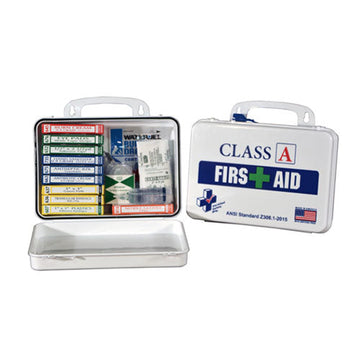
Class A provides a basic range of supplies for common injuries such as cuts, abrasions, minor burns, and eye injuries. It can be a starting point for lower-risk office or retail settings, subject to the site assessment.
Explore our first aid kits and check individual product documentation for Class A specifications.
Class B: More Complex or Higher Risks
Class B provides a broader range and larger quantities of supplies for environments with greater injury risks. Compare this class for industrial, warehouse, and construction work, then assess any additional supplies needed.
Browse workplace first aid kits and confirm which products document Class B conformity.
Sources: ISEA’s 2021 revision summary and First Aid Only’s 2015 comparison.
Compare Coverage Before Comparing Price
| What to compare | Class A | Class B |
|---|---|---|
| Intended coverage | Common workplace injuries | More complex or higher-risk injury situations |
| Range of supplies | Basic wound, burn, and eye-care supplies, with protective items | Broader range, including additional trauma-related supplies |
| Quantities | Basic minimum fill | Higher quantities for many items |
| Tourniquet | Not part of the minimum Class A fill | Included in the minimum Class B fill |
| Foil blanket | Included under the 2021 specification | Included under the 2021 specification |
| Additional supplies | Assess site-specific needs beyond the selected kit’s minimum contents. | |
Ask for the full contents list and the standard edition. Check quantities, item sizes, expiry dates, and container suitability against the documented specification. A generic “OSHA compliant” product description is not enough to decide whether the kit suits your workplace.
Choosing First Aid Supplies by Workplace Type
Offices and Low-Risk Retail
Start by assessing routine injuries and access across the premises. A Class A kit may suit the risks, but a single kit may not serve separated floors, locked areas, or multiple shifts effectively.
Choose an accessible location employees know. Avoid arrangements that delay access while someone looks for a key or waits for a manager. Set a regular inspection schedule; a monthly check can be a practical starting point for a low-use office, with replenishment after use.
Compare first aid kits for offices and verify the specification for the product you select.
Manufacturing, Warehousing, and Industrial Work
Review machinery, cutting tasks, chemical handling, and the distance between work areas. Consider Class B coverage where risks justify it, with additional stations or supplies based on the facility layout and likely demand.
Assess whether dedicated bleeding control kits are appropriate. These may supplement the core kit with equipment such as tourniquets, hemostatic dressings, and pressure dressings. Match equipment to the response plan and responder training.
Construction: Specific Checks Under 29 CFR 1926.50
The construction first aid standard includes requirements beyond simply purchasing a kit:
- Protect the contents: use a weatherproof container with individual sealed packages for each type of item.
- Inspect before dispatch and at least weekly on each job: replace supplies that have been used.
- Plan trained first aid coverage: a person with a verifiable first aid training certificate must be available where medical care is not reasonably accessible in time and distance.
- Address corrosive exposure: provide suitable facilities for immediate flushing or drenching where eyes or the body may be exposed to injurious corrosive materials.
- Arrange emergency response: plan prompt transport or effective communication with ambulance services.
For mobile crews, decide how supplies will remain accessible as work locations change. A vehicle kit can help, but the cited federal rule does not impose a universal kit-on-every-vehicle requirement.
Schools and Educational Settings
Review the rules for your state, school type, staff, and student health program. Confirm the applicable workplace-safety jurisdiction as well as education requirements before standardizing supplies.
- Check state and district requirements for epinephrine and staff authorization or training.
- Review AED placement, access, and maintenance under the school’s applicable rules.
- Account for classrooms, sports facilities, workshops, field trips, and separated buildings.
A common purchasing specification can simplify restocking, with additional supplies for areas that have different risks.
Healthcare Facilities
Coordinate workplace first aid supplies with the facility’s clinical emergency procedures. Ask the safety or compliance lead to confirm the licensing, CMS participation, and accreditation requirements that actually apply.
Assess bleeding control supplies as part of the facility’s response plan. Keep inspection records in the format required by your policies and applicable standards.
California First Aid Rules: What to Check in 2026
For general industry, the published California Title 8, Section 3400 calls for adequate first aid materials approved by a consulting physician, maintained in sanitary and usable condition, with frequent inspections and replenishment as needed.
Check the official first aid rulemaking page for adoption and effective-date updates before treating proposed language as an enforceable requirement. California construction employers should also review the applicable Section 1512 requirements.
Five First Aid Readiness Gaps to Fix
Use these checks to review your setup. A kit label alone cannot show whether supplies, access, and response arrangements are adequate.
1. Expired or Missing Supplies
Check expiry dates, package integrity, and quantities. Replace used or damaged items promptly and assign a named person to manage replenishment.
2. Delays Reaching the Kit
Check access during every shift, including when supervisors are absent. Make locations easy to identify and keep the route clear.
3. Supplies That Miss the Risks
Review changes in equipment, processes, and injury patterns. Add supplies where the workplace assessment identifies gaps.
4. No Clear Maintenance Process
Record who checked the kit, what was missing, and when replacements were made. A dated log is useful practice; the federal general-industry first aid rule does not prescribe a universal monthly inspection log.
5. Equipment Without a Response Plan
Where serious bleeding is a foreseeable concern, assess appropriate supplies—including tourniquets—and responder training. Confirm how employees will summon help and reach the equipment.
Planning by Facility Size
Use these as planning examples, not fixed OSHA staffing or kit-count thresholds. Layout, hazards, access, and supply use matter alongside headcount.
Small Offices and Retail Teams
Compare a documented Class A first aid kit with the site’s needs. Decide whether separated areas need their own supplies, name a maintenance owner, and confirm first aid response arrangements.
Growing or Mixed-Risk Facilities
Consider Class B kits for higher-risk work areas and assess supplemental bleeding control kits. Set inspection frequency around the applicable rules and actual use.
Large or Multi-Site Employers
Use a common inspection and ordering process, while allowing different kit specifications for different hazards. Keep responsibility clear at each site and ask Rescue Supply about purchasing options for your organization.
Class selection reference: ANSI’s overview of workplace first aid kits. This guide supports purchasing and planning; confirm the requirements applicable to your workplace.