








As a facility manager, managing property accessibility isn't just about regulatory box-checking it's about mitigating legal liability, ensuring visitor safety, and maintaining seamless operations. When an entrance or transition point requires a wheelchair ramp, choosing the wrong configuration can result in costly code violations, heavy fines, or worse, structural failures and injuries.
This comprehensive procurement guide covers everything you need to know to confidently select, specify, and install commercial-grade wheelchair ramps that meet federal standards and withstand heavy foot traffic.
The Golden Rule of ADA Compliance: The 1:12 Slope Ratio
The Americans with Disabilities Act (ADA) strictly mandates a maximum slope ratio of 1:12 for commercial and public ramps. This means that for every 1 inch of vertical rise, you must have at least 12 inches (1 foot) of ramp run. For example, a 24-inch step rise requires a minimum 24-foot ramp system. Exceeding this steepness makes the ramp unsafe and non-compliant.
1. Commercial Material Science: Aluminum vs. Steel vs. Concrete
Selecting the right material directly impacts your facility's long-term maintenance overhead, upfront capital expenditure, and localized weather resilience.
| Material | Best Used For | Pros | Cons |
|---|---|---|---|
| Anodized Aluminum | Modular setups, high-moisture climates, rapid deployments | Rust-proof, lightweight, high weight-to-weight ratio, zero maintenance | Higher initial material cost than raw wood/steel |
| Heavy-Duty Steel | Permanent high-traffic industrial settings, high-impact zones | Extremely rigid, cost-effective for massive structures, high weight thresholds | Prone to rust if coating scratches; requires regular painting or galvanization |
| Poured Concrete | Permanent architectural integration during initial builds | Indestructible, blends seamlessly with building design | Permanent, highly expensive to install or modify, susceptible to cracking over time |
2. Essential Structural Requirements for Commercial Ramps
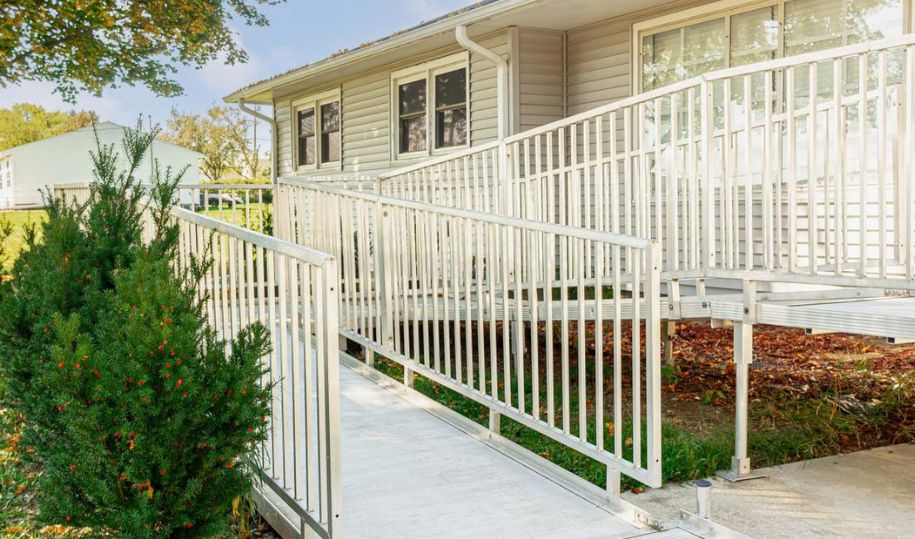
An ADA-compliant commercial ramp is an engineered system, not just an inclined pathway. Your procurement checklist must verify the following structural elements:
Minimum Clear Width
A commercial ramp must offer a minimum of 36 inches of clear, unobstructed width between the handrails. For high-traffic university or hospital facilities, wider configurations (48 to 60 inches) are highly recommended to allow bidirectional traffic flow.
Rest Landings & Turn Platforms
Ramps cannot run indefinitely. ADA requires a flat 60" x 60" minimum landing for every 30 inches of vertical rise, as well as at any point where the ramp changes direction (L-shape or U-shape turns) to prevent user exhaustion.
Continuous Handrails
If a ramp system has a rise greater than 6 inches or a horizontal run longer than 72 inches, continuous handrails on both sides are mandatory. Gripping surfaces must be smooth, uninterrupted, and set between 34 and 38 inches above the ramp surface.
Slip-Resistant Surfaces
Open-mesh flooring architectures or heavily textured solid surfaces are critical for exterior environments. They prevent water, ice, and mud accumulation, guaranteeing traction for manual wheelchairs, motorized chairs, and pedestrians alike.
3. Small Steps, Big Hazards: Threshold Ramps
Not all accessibility challenges involve multi-foot elevation changes. Doorways, raised sliders, and minor curb transitions ranging from 1/2 inch to 6 inches frequently present trip hazards. For these applications, high-durability rubber or aluminum threshold ramps provide an immediate, cost-effective, and code-compliant solution without requiring major structural modifications.
4. The Facility Manager's Pre-Purchase Checklist
Before issuing an RFP or finalizing an order with your supplier, ensure your engineering team has documented these specific site variables:
- Exact Total Rise: Measure the exact vertical distance from the upper landing down to the lowest ground surface point.
- Total Footprint Availability: Map out the surrounding physical layout. Is there enough linear clearance to accommodate the required 1:12 run along with the necessary 5'x5' flat approach landings?
- Substrate Stability: Identify the anchoring surface. Will the system rest on asphalt, concrete, solid earth, or loose gravel? This determines the required anchoring kits and footings.
- Local Building Codes: Keep in mind that some municipalities impose guidelines (such as IBC or local civil codes) that are even stricter than federal ADA minimums. Always cross-reference local requirements.
Simplify Your Facility’s Accessibility Procurement
Navigating structural compliance, engineering specs, and bulk budgeting can be complex. Our dedicated B2B commercial team acts as an extension of your staff, providing stamped engineering drawings, custom configurations, and volume tier pricing.
Shop Commercial & ADA Ramps