







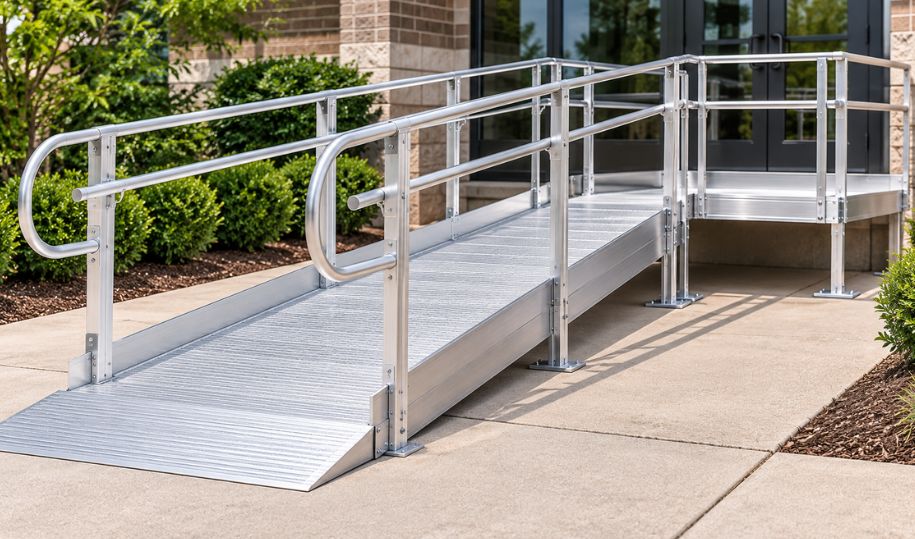
Ensuring your building is accessible to all individuals isn't just a matter of regulatory compliance it’s about providing safety, inclusivity, and dignity for every visitor, employee, and client. If your facility features steps, raised entryways, or uneven elevations, finding the correct commercial wheelchair ramp is essential. This comprehensive guide walks you through the critical factors required to select the ideal option for your business, clinical, or industrial layout.
1. Understanding ADA Compliance Requirements
When installing an accessibility option for a public space or workplace, ADA (Americans with Disabilities Act) compliance is non-negotiable. The specifications dictate strict dimensional ratios to guarantee self-propelled or assisted users can ascend safely.
- The 1:12 Slope Ratio: The core standard for commercial systems mandates that for every 1 inch of vertical rise, you must have at least 12 inches (1 foot) of horizontal ramp run.
- Minimum Usable Width: Ramps must maintain a minimum clear width of 36 inches between handrails to comfortably accommodate standard wheelchairs and mobility equipment.
- Resting Landings: If your configuration features a continuous run longer than 30 feet, a level landing platform is legally required to avoid user overexertion.
Quick Calculation Checklist:
Measure the exact vertical rise from the ground to your highest threshold. If your doorway rise measures 24 inches, your layout demands a minimum of 24 feet of straight ramp run to align fully with standard commercial safety codes.
2. Selecting the Perfect Ramp Configuration
Different architectures demand tailored setups. Depending on your building layout and spatial availability, you will generally choose between three primary system types:
Modular Systems
Modular ramps are the ultimate solution for permanent or long-term building access. Constructed from interconnected sections, they can adapt cleanly to complex L-shaped, U-shaped, or direct layouts, optimizing space where straight paths aren't possible.
Portable & Folding Systems
Ideal for locations requiring seasonal adjustments or rapid setups. Single-fold, multi-fold, or suitcase designs allow operators to deploy heavy-duty paths for specific events or transit needs, and then quickly store them away.
3. Evaluating Heavy-Duty Materials
Material choice directly impacts long-term maintenance costs, structural lifecycle, and cold-weather performance. Keep these attributes in mind:
Aluminum (Recommended)
Widely regarded as the gold standard for facility management. Aluminum structures are exceptionally lightweight yet maintain high structural integrity. They are entirely rust-proof, handle severe environmental stress, and typically feature open-mesh deck surfaces that shed rainwater, ice, and snow effortlessly.
Steel
While offering immense structural weight capacity at a lower initial price point, steel requires ongoing maintenance to avoid rust, chipping, and weathering. It is substantially heavier to install and anchor compared to aluminum options.
Rubber
Best reserved specifically for small threshold entries and doorway lips. Heavy-duty rubber transitions rest right against the frame, offer seamless slip-resistant traction, and require zero anchoring hardware to stay perfectly secure.
Upgrade Your Facility’s Accessibility Today
Ensure your building aligns with code while offering elite safety. Explore our line of professional-grade mobility solutions.
Browse Commercial Wheelchair Ramps