





Shopping for a wheelchair ramp usually starts with one question: what's it going to cost? The second question follows fast — aluminum or steel?
These two decisions are connected in ways most buyers don't realize until they've already placed an order. Making the wrong call can add cost on both ends: upfront and over time.
This guide covers what aluminum wheelchair ramps actually cost in the United States, what drives that number up or down, and how aluminum stacks up against steel across the things that matter most for everyday use.
Quick takeaway: Aluminum wheelchair ramps generally offer a strong combination of durability, portability, corrosion resistance, and low maintenance. The right choice still depends on your ramp length, width, configuration, load requirements, and intended application.
What Aluminum Wheelchair Ramps Cost in 2026
Wheelchair ramp prices vary based on width, length, configuration, and whether you're buying for residential or commercial use. Here's a realistic breakdown.
Residential Aluminum Ramps
| Type | Typical Price Range |
|---|---|
| Short portable ramp (2–4 ft) | $150 – $400 |
| Modular system, 6–10 ft run | $500 – $1,200 |
| Modular system, 12–20 ft run | $1,200 – $3,000 |
| Roll-up portable ramp (30"–36" wide) | $1,000 – $1,500 |
Commercial Aluminum Wheelchair Ramps
Commercial systems cost more because they're built to higher load ratings and wider widths. The Rampit USA United Series available at Rescue Supply in 48, 54, 60, and 72-inch widths is priced on request due to the custom configuration involved for each institutional application.
What Drives the Price Up?
- Width: A 72-inch commercial ramp costs significantly more than a 36-inch residential one.
- Run length: Longer rises require more sections; a 24-inch rise needs at least 24 feet of ramp at 1:12.
- Landing platforms: Switchback configurations with intermediate landings add material cost.
- Installation: Professional installation typically adds $300 – $800 depending on complexity.
- Brand and material grade: 6005-T5 aluminum costs more than standard alloy but outlasts it significantly.
What You're Actually Paying For
A $2,000 aluminum wheelchair ramp and a $400 one can both look similar in a product listing. The difference shows up in load capacity, surface texture, how the sections connect, handrail quality, and whether the system meets ADA slope specifications out of the box or requires adjustment.
Residential Use
For residential use, budget systems are often fine when the ramp meets the required dimensions, slope, capacity, and application needs.
Commercial & Healthcare
For commercial or healthcare applications, a ramp rated to 1,000 lbs with factory-certified ADA compliance is worth the premium.
Why Aluminum Became the Standard Material for Wheelchair Ramps
Aluminum took over the wheelchair ramp market for practical reasons, not marketing ones. Its combination of corrosion resistance, lower weight, durability, and minimal maintenance makes it particularly useful for wheelchair and mobility applications.
It Doesn't Corrode
Steel rusts. Even galvanized steel develops surface rust at cut edges, fastener holes, and scratched areas. In states with salt air — Florida, California, coastal South Carolina — or states that use road salt in winter — Minnesota, Michigan, Ohio — a steel ramp's lifespan drops fast.
Aluminum forms a passive oxide layer on exposure to air that actually protects the underlying metal. It doesn't rust, and no coating or painting is required to maintain that protection.
The Weight-to-Strength Ratio Is Better for Portable Use
A steel ramp section that can hold 800 lbs is significantly heavier than an aluminum section with the same rating. For portable ramps and modular systems that get moved, reconfigured, or shipped, that weight difference matters.
Why this matters: Aluminum ramps can be repositioned by one or two people without equipment. Many steel ramp sections require a lift.
It Holds Up in Freeze-Thaw Cycles
Repeated freezing and thawing stresses materials at the molecular level. Wood splits, concrete cracks, and painted steel can delaminate. Aluminum expands and contracts with temperature changes without degrading structurally.
In northern states where temperatures swing dramatically across seasons, this can make a real difference in how long the ramp performs without maintenance.
No Maintenance Required
Aluminum wheelchair ramps from quality manufacturers carry lifetime warranties specifically because there's little to do after installation. No painting, no sealing, no refinishing.
The Rampit USA series sold through Rescue Supply is built to this standard — the aluminum will outlast the building it's attached to in most cases.
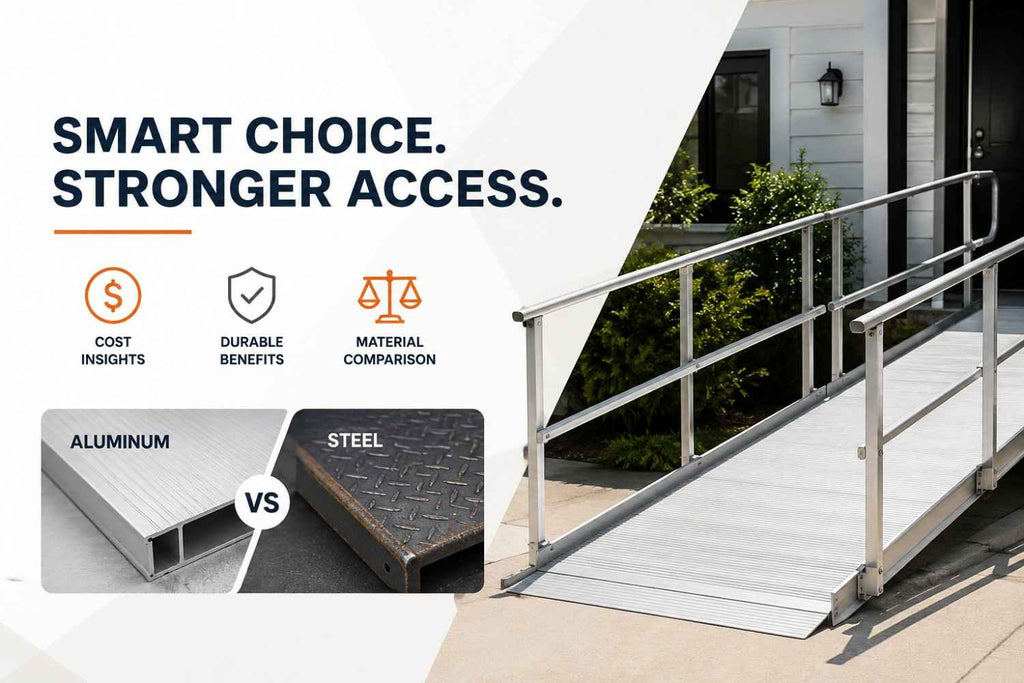
Steel vs. Aluminum Wheelchair Ramps: A Direct Comparison
The best material depends on the application, but comparing the two materials side by side makes the differences much easier to understand.
| Factor | Aluminum | Steel |
|---|---|---|
| Rust resistance | Excellent — no coating needed | Poor to moderate — requires galvanizing or paint |
| Weight | Light — easier to move and install | Heavy — typically 2x heavier per section |
| Maintenance | None required | Periodic repainting, rust treatment |
| Load capacity | Up to 1,000+ lbs commercial grade | Can be higher for custom fabrication |
| Cost | Moderate upfront, low lifetime cost | Lower upfront, higher lifetime cost |
| ADA compliance | Pre-engineered systems available | Usually custom-built on-site |
| Lifespan | 20+ years with no maintenance | Varies significantly based on coating maintenance |
| Availability | Widely available in modular systems | Mostly custom fabrication |
When Steel Might Make Sense
Steel ramps are sometimes used in heavy industrial applications where load requirements exceed what standard aluminum systems are rated for.
If you're building a permanent ramp for a loading dock that handles pallet jacks and forklifts, steel fabrication may be the answer.
For anything involving a wheelchair, mobility scooter, or power chair, aluminum is the right material.
Are Aluminum Wheelchair Ramps Safe in Wet and Winter Conditions?
This is one of the most common questions buyers ask. The answer depends heavily on the surface design.
Surface Types and What They Mean
- Open mesh / diamond plate: Allows water and snow to drain through or off the surface; excellent wet-weather traction.
- Solid flat aluminum: Water pools on the surface; requires a non-slip coating or tape to be safe when wet.
- Raised tread / knurled surface: Uses a machined grip pattern in the aluminum itself and performs well in most conditions.
For outdoor use, surface design matters just as much as the ramp material. Aluminum itself may resist corrosion, but the ramp still needs an appropriate traction and drainage design for wet and winter conditions.
The National Ramp Breeze Series available through Rescue Supply uses open mesh specifically for wet-weather performance. The Roll-A-Ramp systems use a raised tread design. Either works well for outdoor use in rain and snow. A flat, uncoated aluminum surface does not.
Cold Climate Considerations
Ice on a ramp surface is a serious safety concern. Open-drain surfaces help because water doesn't pool. For climates with significant ice accumulation, some facilities add heated cable systems under the ramp surface.
This is a building systems decision more than a ramp selection decision, but it's worth raising with your installer if you're in Minnesota, Wisconsin, Maine, or similar northern states.
Need Help Choosing the Right Wheelchair Ramp?
Compare ramp options based on your required length, width, configuration, application, and accessibility needs.
Browse Wheelchair Ramps