Consumer shower chairs are built for one person, one bathroom, occasional use. Facility chairs live a different life: rolled between rooms all day, disinfected between every resident, and loaded by whoever is on the census — including bariatric patients a home chair was never designed for. The buying decisions are different too, and they start with the frame material.
How to choose a shower or commode chair for a facility
Start with the frame, because the wet room decides how long a chair lives. IPU and MJM build their institutional chairs from healthcare-grade PVC pipe and fittings, and PVC simply does not rust: there is no coating to chip, no weld to corrode, and no metal frame quietly weakening under daily water and disinfectant exposure. The MJM bariatric frames are reinforced at the stress points — the largest uses a pipe-within-a-pipe design — which is how a plastic-framed chair legitimately reaches the capacities listed below.
Infection control is the second decision, and it is built into the materials. The PVC frame is non-porous, so fluids and biofilm have nowhere to settle into the surface, and it wipes down with hospital-grade disinfectants between residents. Backrests on these chairs are breathable antimicrobial mesh that dries quickly and removes for sanitizing, and the seats are smooth, soft-seat designs without the crevices that make consumer chairs a cleaning problem. For shared shower rooms, that cleanability is the feature that gets used every single shift.
Match capacity and width to your census, not to the average resident. Standard institutional chairs are rated at 300 lbs with an internal seat width around 17–18 inches. Mid-size models step to 350–375 lbs and 22 inches between the arms. Oversize and bariatric models run 400–425 lbs and up — the IPU 700 is rated at 700 lbs with a 30-inch interior width, and the MJM Deluxe Bariatric reaches 900 lbs. Buying one bariatric chair before you need it is cheaper than improvising on the day a 450 lb resident arrives.
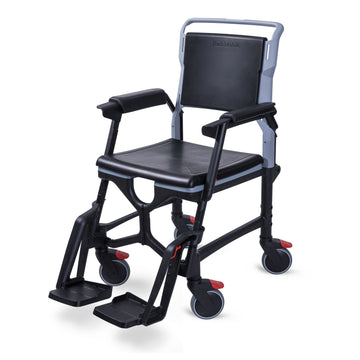
Decide the configuration around the work the chair has to do. A shower commode chair combines three jobs — transport, showering and toileting — so one chair replaces separate equipment and cuts the number of transfers staff perform. Check the seat clearance against your toilets: the IPU Original Line, for example, has a 17-inch seat clearance so it rolls directly over a standard institutional toilet, and its slide-out commode pail handles bedside use. Open-front seats give caregivers perineal access without repositioning the resident; drop arms and swing-away arms simplify lateral transfers; tilt-in-space models serve residents who cannot hold an upright posture. Then check the casters: 3-inch twin casters are standard across much of the range, with locking and total-lock options for transfers on wet floors.
1 · Choose PVC for the wet room
Healthcare-grade PVC frames cannot rust, chip or corrode — the frame decision that decides service life in a shower room.
2 · Rate capacity to the census
300 lbs standard, 350–425 lbs mid-size and oversize, and dedicated bariatric models rated to 700 and 900 lbs.
3 · Pick the seat and arms
Open-front seats for hygiene access, drop or swing arms for lateral transfers, tilt-in-space for postural support.
4 · Check fit and casters
Confirm seat clearance over your toilets, then caster size and locking for safe transfers on wet floors.