



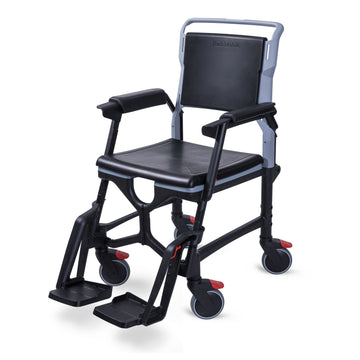

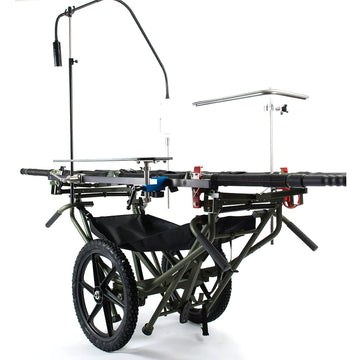

SECA 676 EMR Ready Wheelchair Scale with Handrail
Handrail support and transport castors on an EMR-ready platform, built for daily ward weighing.
View product
Rescue Supply · Clinical Equipment
A patient who cannot stand still needs an accurate weight: medication dosing, dialysis, nutrition and anesthesia all run from it. This guide compares the four scale formats that solve the problem, wheelchair, chair, platform and bed scales, then covers capacity, ramps and handrails, and the data connection to the chart.

Every format answers the same question differently: how much transfer is acceptable? A patient who arrives in a wheelchair should ideally be weighed in it; a patient who can transfer once can use a chair scale; a patient who cannot leave the bed needs the weighing built into the bed or the lift.
A low platform with ramps on one or both sides: the patient rolls on in their own chair and the scale tares out the chair's weight. The default choice for rehab, dialysis and long-term care, and the format with the widest model range. Browse wheelchair scales
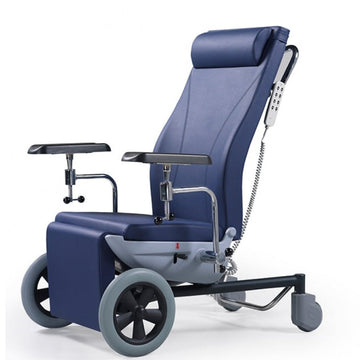
A seat on a weighing frame for patients who can transfer from wheelchair to chair but cannot stand safely. Chair scales such as the SECA 952 are compact, mobile on castors, and common in wards and clinics.
A flat, high-capacity platform for standing patients who need a handrail and a wide base, and for wheelchair users at higher weights. Bariatric models step up in capacity, platform size and rail strength together. Browse bariatric scales
When the patient cannot transfer at all, the scale goes to the patient: bed scales weigh from under the bed frame and lift scales weigh during a hoist transfer. Slower per weighing, but they are the only accurate option for fully dependent patients.
| Wheelchair scale | Chair scale | Platform / bariatric scale | |
|---|---|---|---|
| Who it suits | Patients who stay in their wheelchair | Patients who can transfer to a seat | Standing patients and higher weights |
| Transfer count | None: roll on, roll off | One transfer each way | None for wheelchair use; step-on for standing |
| Chair weight handling | Tare function subtracts the wheelchair | Not applicable | Tare function subtracts the wheelchair |
| Space it needs | Platform plus ramp run-off | The smallest footprint of the three | Wide, level floor area |
| Typical setting | Dialysis, rehab, long-term care | Wards, clinics, physician offices | Bariatric programs, admissions |
Size a wheelchair or platform scale for patient plus chair, not patient alone. A powered wheelchair can weigh as much as a second person, so a scale that is adequate for the patient can be overloaded by the combination. Bariatric programs should work from the heaviest expected combination and keep headroom above it, the same discipline as any rated equipment.
Then check graduation: the increment the scale reads in. Clinical weighing for dosing and dialysis works in fine increments, and EMR-ready models from SECA and Detecto record the result directly, which removes the transcription error that creeps in when a weight is called across a room and written down later.

A scale that is awkward to board gets skipped, and skipped weights become estimated weights. These details decide whether the scale is used every time:
The weighing takes seconds; the recording is where errors happen. Modern clinical scales close that gap:
Scales badged EMR-ready, including the SECA 664, 676 and 634 and the Detecto 6550, transmit the weight to the electronic record instead of relying on a handwritten note.
Models with a height rod or height entry calculate BMI at the scale, so the figure in the chart is computed, not estimated at a desk later.
Tare stores the wheelchair's weight so repeat visits weigh faster; hold freezes the reading on an unsteady patient until staff can record it.
Battery operation frees the scale from outlet hunting in wards and lets portable models work anywhere; mains suits fixed bays. Confirm which a model uses before siting it.
Five checks before a scale goes on an order:
Active clinical scales from the store: SECA and Detecto wheelchair, chair and bariatric models, ready for ward, dialysis and rehab use.
Handrail support and transport castors on an EMR-ready platform, built for daily ward weighing.
View product
A portable, EMR-ready wheelchair scale that folds to serve several rooms.
View product
For patients who can transfer to a seat but cannot stand: compact, mobile and ward-friendly.
View product
A wide, high-capacity platform for bariatric programs and standing patients who need room and support.
View product 01
Platform scales with ramps from SECA, Detecto, ConvaQuip and LW Measurements.
Browse the collection 02
Seated weighing for patients who can transfer but cannot stand.
Browse the collection 03
Higher capacities, wider platforms and height rods for bariatric programs.
Browse the collection 04
The wider medical range: physician, platform, infant and specialty scales.
Browse the collectionOn a wheelchair scale: the patient rolls onto the platform in their chair and the scale's tare function subtracts the wheelchair's weight, which is weighed once and recorded. The patient never transfers, and the result is a true body weight rather than an estimate.
Size for the patient and the wheelchair together. Powered wheelchairs are heavy, and bariatric combinations heavier still, so work from the heaviest combination you expect and keep headroom above it rather than buying at the limit.
If most patients arrive in wheelchairs and can stay in them, a wheelchair scale is faster and safer. A chair scale suits clinics where patients walk in or transfer easily, and its smaller footprint fits rooms a platform cannot. Many wards run one of each.
The scale can send the measured weight directly to the electronic medical record instead of staff transcribing it. Models such as the SECA 664, 676 and 634 and the Detecto 6550 carry this designation; confirm the interface your record system expects before ordering.
Yes, if it is built for it: portable models with transport castors and folding ramps, such as the Detecto 6550 and SECA 676, move between rooms. Battery power helps, since the scale is not tied to an outlet position.
Follow the manufacturer's interval and your facility's biomedical policy, and log each check. A scale used for medication dosing or dialysis is a measuring instrument in clinical service, and its calibration record is part of survey readiness.
Keep Reading
Hospitals & Clinics
Tell us your patient mix, the heaviest combination you expect and whether weights feed your EMR, and we will quote the right formats as one institutional order.
Product selection guidance is informational. Check current specifications, availability, manufacturer instructions and any applicable clinical, safety or regulatory requirements before purchasing.