





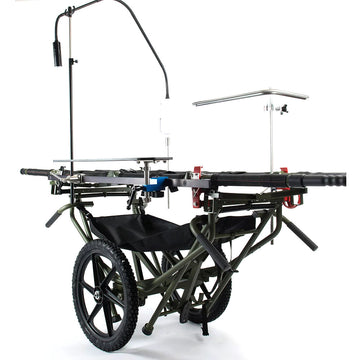

BestMove® STA400 Standing Transfer Aid Patient Lift
The BestMove® STA400 — the best-known standing transfer aid in home and rehab care.
$689.00
View product

Rescue Supply · Patient Lifts
Two lift families, one deciding question: how much can the person help? This comparison covers who each lift suits, the slings they use, the transfers they handle — and the expensive mistake of buying the wrong one.

A sit-to-stand lift (also called a stand aid or stand-assist lift) raises the user from sitting to a supported standing position. The user places their feet on a footplate and their shins against a knee pad, holds the handles, and a padded sling around the back and under the arms helps them up as the lift rises. The user is participating, not being carried — which is exactly the point: sit-to-stand transfers keep legs working, make toileting straightforward (clothing can be managed while the user is supported), and are quicker for the short bed-to-chair and chair-to-commode moves that fill a care day. They suit people with reasonable upper-body strength and trunk control who can bear a good share of their weight through their legs. They cannot lift someone who cannot do those things, and they cannot pick anyone up from the floor.

A full patient lift — the type most people mean by "Hoyer lift" — carries the user’s entire weight in a sling suspended from a boom. The user contributes nothing but cooperation, which makes a full lift the answer for non-weight-bearing users, users with little trunk control, and heavier users. Full lifts handle every transfer type, including lifting from the floor after a fall (on models whose boom lowers far enough), and they come in manual hydraulic and battery-electric versions across a wide capacity range — up to 700 lb on bariatric floor lifts like the Handicare FGA-700. The trade-offs are size, sling time, and a more passive experience for the user.

| Sit-to-stand lift | Full patient lift | |
|---|---|---|
| Who it suits | Can bear weight through the legs; some trunk and upper-body control | Little or no weight-bearing ability; limited trunk control |
| How the user is supported | Standing sling at the back/waist; feet on a footplate, knees against a pad | Full-body sling underneath the user, suspended from a boom |
| Transfer tasks | Bed ↔ chair, chair ↔ commode, standing practice | Bed ↔ chair, commode, bathing, and floor recovery |
| Toileting | Excellent — user is upright and clothing is accessible | Possible with a toileting sling |
| Floor recovery | No | Yes, on models whose boom reaches floor level |
| User participation | Active — maintains leg strength and involvement | Passive — the lift does the work |
| Footprint & effort | Smaller, lighter, simpler to store and steer | Larger; electric versions keep caregiver effort low |
| Sling types | Standing / transport slings | Universal, full-body, toileting, mesh and repositioning slings |
Buyers compare lifts and forget that the sling is what the user actually feels. Sit-to-stand lifts use standing slings that support the back and connect under the arms; the user’s legs do the rest. Full lifts use full-body slings in several cuts — universal, high-back for head support, toileting, mesh for bathing — sized by the manufacturer’s chart from the user’s weight and measurements. A sling that is the wrong size or style for the lift’s spreader bar is the most common reason a "wrong lift" turns out to be a wrong purchase. The sling deep-dive, including sizing, is in our Electric Patient Lifts for Home Use guide, and bariatric-rated slings are in the Bariatric Patient Lift Sling collection.
Capacity follows the same rule on both types: the rating (safe working load) must exceed the user’s weight with margin. Sit-to-stand aids generally carry lower ratings than full lifts, and they add a second condition — the user must be able to use their legs regardless of what the scale says. For heavier users, the full-lift side scales much further: the Bariatric Patient Lift collection runs to reinforced models like the 700 lb Handicare FGA-700 floor lift, paired with bariatric slings rated to match. Never run any lift — or sling — at the edge of its rating as a daily routine.
Sit-to-stand aids are the smaller machines: shorter bases, tighter turns, easier storage in a bedroom corner. Full lifts need room to open their base legs around beds and chairs and to rotate with a suspended user, and compact models exist for small rooms. Both types roll best on hard floors or low-pile carpet, and both publish base widths — closed for doorways, open for furniture — that are worth measuring against your home before the box arrives.
The BestMove® STA400 — the best-known standing transfer aid in home and rehab care.
$689.00
View product
The STA450 steps up the platform for users who need a larger standing aid.
$882.00
View product
A manual hydraulic sit-to-stand lift — powered-lift function without a battery to manage.
$1,183.95
View product
400 lb hydraulic full lift — the straightforward manual option for total-assist transfers.
$783.00
View product
350 lb battery-powered lift that folds for storage — full-lift function, apartment footprint.
$2,350.95
View product
507 lb aluminum electric lift with powered positioning, for heavier users and daily transfers.
$1,819.95
View productDecided on a full electric lift for a home? The home-use guide covers capacities, room fit, slings and batteries in depth. Considering a permanent installation instead? See the Ceiling Lift Guide.
A sit-to-stand lift raises a user who can bear weight through their legs to a supported standing position, using a standing sling; the user participates in the transfer. A full lift carries the user’s entire weight in a full-body sling and requires nothing of the user. Weight-bearing ability is the deciding factor.
Anyone who cannot bear weight through their legs, hold on, or maintain enough trunk control to stay positioned against the knee pad — including many non-weight-bearing users. Suitability is individual; confirm with the user’s clinician or therapist, especially if strength is declining.
Yes. Both sit-to-stand aids and full lifts are routinely operated by a single caregiver at home. Electric models reduce the physical effort most. Follow the manufacturer’s instructions and practice the transfer before relying on it.
Hoyer is a manufacturer brand whose name became the common shorthand for a full-body patient lift — a mobile lift that raises a user in a sling from a boom. Many brands make equivalent lifts; "hoyer lift" in a search usually means any full patient lift.
Yes. Sit-to-stand lifts are particularly good for toileting because the user is upright and clothing can be managed while they are supported. Full lifts handle toileting with a toileting sling, which has an open section designed for the purpose.
More than the user weighs — choose a safe working load above the user’s weight with margin, and check the sling’s rating matches. Standard models run roughly 350–450 lb and bariatric full lifts reach 700 lb. If the user is near a model’s limit, move up a class.
No. A sit-to-stand lift starts from a seated position and requires the user to bear weight. Lifting from the floor takes a full patient lift whose boom lowers to floor level (or a dedicated lifting cushion).
A full patient lift — it is the only type that carries the user’s entire weight in a sling. A sit-to-stand aid cannot be used safely by someone who cannot bear weight through their legs.
Keep Reading
Still Deciding
Tell us what the user can and cannot do, their weight, and the transfers you need. A specialist will point you at the right type and size before you spend anything.
Product selection guidance is informational. Check current specifications, availability, manufacturer instructions and any applicable clinical, safety or regulatory requirements before purchasing.