Bleeding Control Stations for Schools & Public Facilities: The HB 496 Buying Guide

Rescue Supply · Guide

Bleeding Control Stations for Schools & Public Facilities: The HB 496 Buying Guide

Since January 1, 2020, every Texas public and charter school campus has been required to run a bleeding control station program — a stocked station, in an accessible place, under a written traumatic-injury protocol. This guide walks through what Education Code §38.030 actually requires, the eleven contents a compliant station kit must hold, where stations belong on a campus or in a facility, and how to choose between the kit tiers that meet the standard.

Tex. Educ. Code §38.030 Treat 8 or treat 5 Co-locate with AEDs Annual training
Cubix Safety OWC-M-BC outdoor alarmed bleeding control wall cabinet

The mandate: what §38.030 requires

House Bill 496 (86th Texas Legislature, 2019) added Section 38.030, "Traumatic Injury Response Protocol," to the Education Code after the 2018 Santa Fe High School shooting exposed how long professional help can take to reach a bleeding victim. The statute is not advisory. Each school district and open-enrollment charter school must develop a traumatic injury response protocol, make it available annually, and implement a bleeding control station program at each campus — a deadline the law set at January 1, 2020.

Four obligations sit on top of the hardware. The stations must be stored in easily accessible areas selected by the district's school safety and security committee (or the charter school's governing body). The use of the stations must be written into the campus's security planning, including the multihazard emergency operations plan. Training approved by the Texas Education Agency must be provided to commissioned peace officers, school security personnel, school resource officers, and every other employee reasonably expected to use a station — including instruction on proper chest seal placement, using nationally recognized, evidence-based bleeding control guidelines. And every student in grade seven or above must receive instruction on the use of a bleeding control station annually, with a parental opt-out. The statute also shields districts and employees from civil liability for the good-faith use of a station, absent gross negligence.

Outside Texas, no identical mandate may apply — but the model is national. The federal Stop The Bleed campaign, launched in 2015, promotes the same three moves everywhere: a stocked bleeding control station in a public place, supplies matched to a written standard, and bystanders trained to use them. Texas simply wrote the model into law first, which is why its contents list has become the de facto specification sheet for school and facility stations nationwide.

What a compliant station contains

Section 38.030(e) names the kit contents item by item. A district picks one of three sizing options: option one, quantities to treat eight injured persons; option two, quantities to treat five; or option three, quantities the superintendent determines appropriate. Under either of the first two options, the kit must hold tourniquets that include a locking mechanism — eight under option one, five under option two. Chest seals and patient care cards follow the same eight-or-five pattern. Five pairs of latex-free gloves and five space emergency blankets are required under both fixed options, as are two hemostatic-impregnated gauze dressings, two permanent markers, two pairs of trauma shears, and two compression bandages. Every station, regardless of option, must also hold one hard-shell case and one emergency alerting device.

Read that list against the products in this category and the architecture is plain: the statute describes a kit, not a shopping trip. The tourniquet line is why station kits are built around named locking platforms — the C-A-T, the SAM XT, and their equivalents — rather than elastic straps. The marker is not stationery; it records tourniquet application time for the medics who take over. The care cards walk an untrained bystander through the sequence. And the hard-shell case and alerting device lines are why the station is a cabinet or sealed case on a wall, not a box in a closet. When a component is used or expires, it is replaced individually — tourniquets, gauze, gloves, blankets and markers are all stocked as separate restock items for that reason.

Placement: accessible, visible, and beside the AED

The statute leaves siting to the local safety committee but sets the test: easily accessible areas of the campus. In practice that means the places a crowd already is and a responder can reach in under a minute — the front office and main hallways, the cafeteria, the gym and athletic facilities, the auditorium, and shop or lab wings where injuries concentrate. Larger campuses run more than one station; the program is per campus, not per district, and a station locked in a nurse's office fails the accessibility test the law describes.

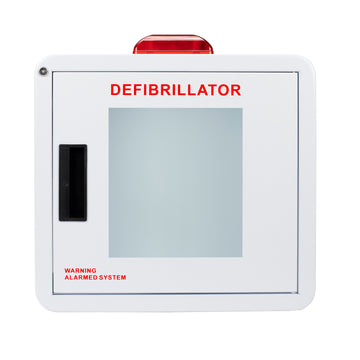
The placement decision the Legislature anticipated is co-location with the AED. An amendment written into the bill expressly allows committees to select the areas where automated external defibrillators are stored as the bleeding control station locations, and combination cabinets exist that house an AED and a bleeding control kit behind one alarmed door. Co-location pays twice: staff learn one life-safety wall per building, and the inspection cycle — pads and batteries on the AED side, seals and expiration dates on the bleeding side — runs as a single route. Outdoor placements, at stadiums, field houses and campus exteriors, call for weatherproof alarmed cabinets built for public access. Wherever the station sits, mark it: three-dimensional wall signs, on-site decals and an instructional poster at the station turn a stocked cabinet into a findable one.

Choosing a kit tier

Bleeding control kits are sold in Standard, Intermediate and Premium tiers, and the tiers describe contents, not quality grades. A Standard kit covers the statutory core: a locking tourniquet, core dressings and bandages, gloves, shears, marker, blanket and care card. An Intermediate kit upgrades components — a premium tourniquet platform or expanded dressing set — for facilities whose protocol goes beyond the floor. A Premium kit adds a hemostatic dressing such as QuikClot or NuStat on top of the compressed gauze, for campuses and venues that want the strongest dressing option at the station. All three tiers are stocked in the personal format — one kit treats one casualty response — and stations are built by placing multiple kits in the cabinet to reach the district's chosen option-one or option-two count.

Two decisions matter more than the tier label. The first is the tourniquet platform: pick one — C-A-T, SAM XT, QuickTight or SWAT-T — and standardize on it across campuses, because training, restocking and muscle memory all follow the platform. The second is the inspection discipline: a station is only compliant while its contents are complete and in date, so assign the checks to the same route that inspects your AEDs, log them on the station's inspection tag, and restock components the week they are used, not the semester after.

Featured products

Eight products that cover the station end to end — outdoor and combination cabinets, premium and standard kits on two platforms, a Texas-mandate kit from a second manufacturer, an indoor station cabinet, and the SAM XT tourniquet for restocking. The full range lives in our Bleeding Control Kits & Stations collection.

Cubix Safety OWC-M-BC Outdoor Alarmed Bleeding Control Wall Cabinet

Cubix Safety OWC-M-BC Outdoor Alarmed Bleeding Control Wall Cabinet

The outdoor station cabinet: a medium alarmed wall cabinet built for public-access placement, so the station survives weather and stays visible where crowds gather — trailheads, stadiums, campuses and building exteriors.

$97.95

View product
Cubix Safety CB2-AED-BC Combination AED Cabinet with Alarm and Additional Storage

Cubix Safety CB2-AED-BC Combination AED Cabinet with Alarm and Additional Storage

The co-location answer the statute anticipates: one alarmed cabinet that stores the AED and the bleeding control supplies together, so both life-safety stations live on the same wall.

$151.95

View product
Cubix Safety BC3-Pq-CAT Personal Bleeding Control Kit - Premium with QuikClot Dressing and CAT Tourniquet

Cubix Safety BC3-Pq-CAT Personal Bleeding Control Kit - Premium with QuikClot Dressing and CAT Tourniquet

The premium eight-person personal kit: C-A-T windlass tourniquet, QuikClot hemostatic dressing and the full statutory component set in a ready-to-deploy case — the kit tier most campuses standardize on.

$119.95

View product
Cubix Safety STB3-S-CAT Personal Stop The Bleed Kit - Standard with CAT Tourniquet

Cubix Safety STB3-S-CAT Personal Stop The Bleed Kit - Standard with CAT Tourniquet

The standard Stop The Bleed personal kit with a C-A-T tourniquet: the core contents for a single trained responder, sized for classrooms, offices and patrol bags.

$73.95

View product
Cubix Safety BC-I-QT Intermediate Bleeding Control Kit with QuickTight Tourniquet

Cubix Safety BC-I-QT Intermediate Bleeding Control Kit with QuickTight Tourniquet

The intermediate tier on the QuickTight platform: upgraded dressings and components over the standard kit for facilities whose protocol calls for more than the statutory floor.

$89.95

View product
First Aid Only Texas Mandate Bleeding Control Kit | Hemorrhage Control Station

First Aid Only Texas Mandate Bleeding Control Kit | Hemorrhage Control Station

First Aid Only's kit built specifically around the Texas mandate — a second-source option districts use when standardizing contents across campuses.

$162.95

View product
Hearsmart Curaplex Stop The Bleed Metal Wall Cabinet

Hearsmart Curaplex Stop The Bleed Metal Wall Cabinet

Curaplex's metal Stop The Bleed wall cabinet: the indoor station housing for hallways and front offices, stocked from the kit lines below it.

$230.95

View product
Cubix Safety XT600-BK-EN SAM Extremity Tourniquet - Tactical Black

Cubix Safety XT600-BK-EN SAM Extremity Tourniquet - Tactical Black

The SAM XT extremity tourniquet — the locking windlass platform the statute describes, stocked individually for restocking stations and for responder carry.

$45.95

View product

Frequently asked questions

What exactly does HB 496 require of a Texas school district?

Texas Education Code §38.030 requires every district and open-enrollment charter school to adopt a traumatic injury response protocol, maintain a bleeding control station at each campus in an easily accessible area, include the stations in its security planning, and train the personnel reasonably expected to use one. Students in grade seven and above receive instruction on using a station every year. The requirement has been in force since January 1, 2020.

What must be inside the kit at each station?

The statute lists eleven contents: tourniquets that include a locking mechanism, chest seals and patient care cards — eight of each under option one, five under option two, or superintendent-set quantities under option three — plus five pairs of latex-free gloves, five space emergency blankets, two hemostatic-impregnated gauze dressings, two permanent markers, two pairs of trauma shears, two compression bandages, one hard-shell case and one emergency alerting device.

Can the bleeding control station share a cabinet or location with the AED?

Yes. The statute expressly allows the safety and security committee to select the areas where AEDs are stored as the easily accessible areas for bleeding control stations, and combination cabinets that house an AED and bleeding control supplies together are built for exactly that layout.

We are not a Texas school. Does any of this apply to us?

The mandate itself binds Texas public and charter schools, but the station model comes from the national Stop The Bleed campaign and is the template facilities, employers and public venues in every state use for traumatic bleeding readiness. The same cabinets, kits and contents apply — only the legal obligation differs.

How often should a station be inspected and restocked?

Inspect on the same cycle as your AED program: confirm the cabinet alarm works, the kit seal is intact, and no component has passed its expiration date — hemostatic dressings, chest seals and gloves all carry shelf lives. Restock any component immediately after use. Inspection documentation tags exist for exactly this check.

Can our district order stations for multiple campuses on one quote?

Yes. Districts standardizing stations across campuses can request an institutional quote covering cabinets, kits and restock components in one order, and purchase orders are accepted on approved accounts. Send the campus count and the option your protocol follows — treat eight, treat five, or superintendent-set — and the quote will be built to it.

Institutional Quotes

Outfitting a campus, a district, or a whole facility?

Send the station count and the sizing option your protocol follows and our quotes team will price the full package — cabinets, kits and restock components — on one institutional quote.

Product selection guidance is informational. Statutory summaries are provided for purchasing guidance and are not legal advice; confirm current requirements with your district counsel and the current text of the Texas Education Code. Check current specifications, availability, manufacturer instructions and any applicable clinical, safety or regulatory requirements before purchasing.

Shipping Information

Standard Ground Shipping

Rescue Supply processes most orders within 24 hours, with items typically shipped from our warehouse within 48 hours using 3-7 business day ground delivery service, unless a different lead time is specified on the product page. Free ground shipping is available exclusively for deliveries within the 48 contiguous United States.

Freight Shipping (Truck Freight)

Heavy items (over 150 lbs), bulk freight, pallet truck items, or custom-fabricated made-to-order products may require extended shipping lead times. Rescue Supply will notify customers as soon as truck freight items are ready for overland shipment within the 48 contiguous United States.

Price Match Guarantee & MAP Policy

Our Price Match Promise

We are committed to offering you the best prices on emergency and safety equipment. If you find a lower advertised price from an authorized dealer on an identical item we carry, we will match that price. Our price match guarantee ensures you always get the best value for your investment in safety and preparedness.

Minimum Advertised Price (MAP) Policy

Many of our products are subject to Minimum Advertised Price (MAP) policies set by manufacturers. This means we cannot advertise prices below the MAP price, but we may be able to offer additional savings at checkout or through special promotions. Contact our customer service team for current pricing on MAP-restricted items.

Price Match Conditions

Price matching applies to identical items from authorized dealers only. The competitor must have the item in stock and available for immediate purchase. Auction sites, marketplace sellers, and unauthorized dealers are excluded. Price matches must be verified before purchase and cannot be applied retroactively.

REQUEST A QUOTE

*Availability varies by location - we'll confirm in your quote if selected.